09Article · AI Short Drama Rhythm
Rhythm in AI Short Drama: Information Divided by Time
Rhythm isn't fast cutting — it's dense information. In a one-minute short drama, too little information and viewers swipe away; too much and they can't keep up. Three formulas handle how emotion moves, the timeline handles how shots are laid out, and sound-picture sync handles where the feeling lands.
01 / The formula
The formula: rhythm is information divided by time
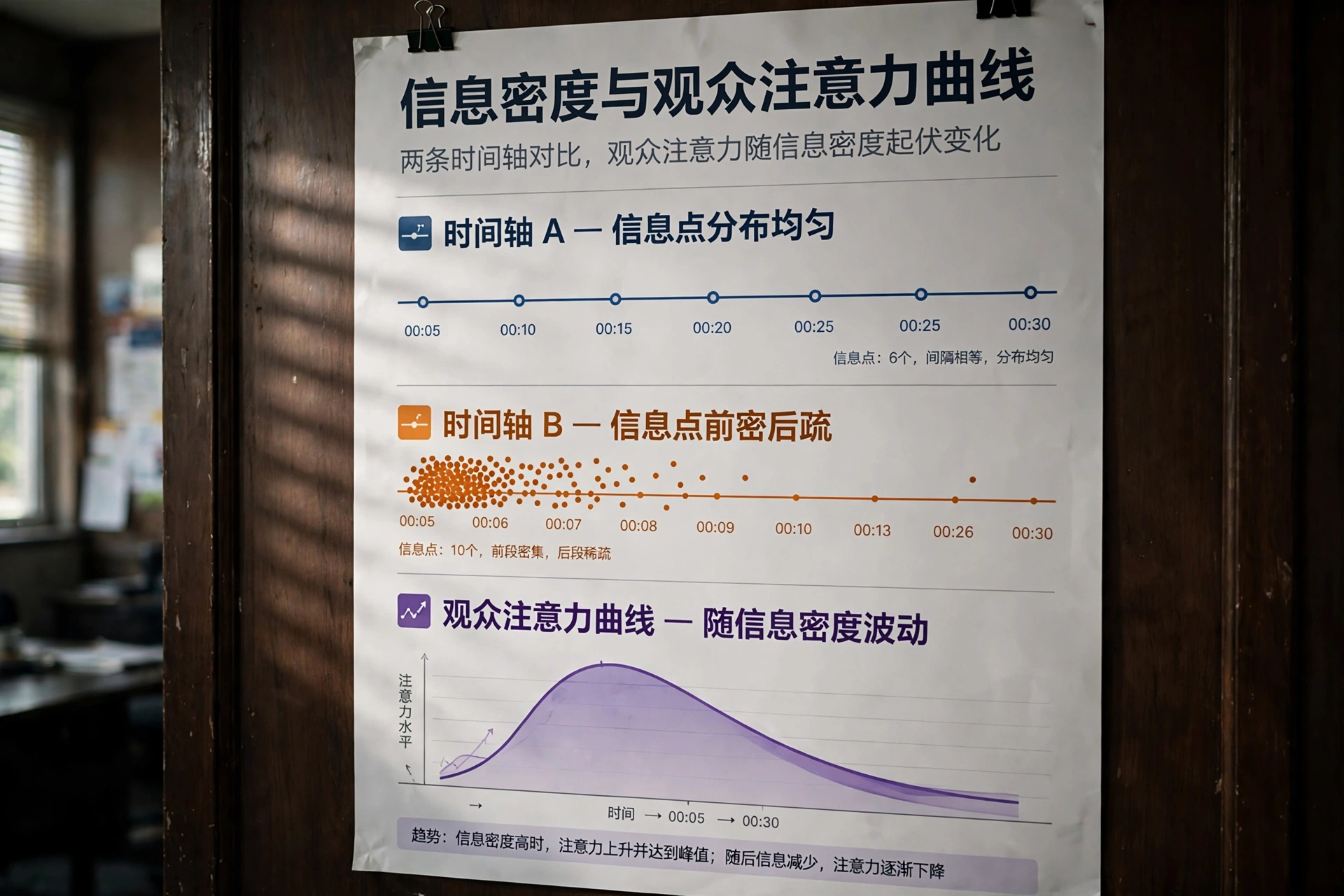
How much a one-minute short drama can hold isn't about how many shots you cut — it's information divided by time. Density too low and viewers feel it drag and swipe away; density too high and they can't keep up, and swipe away anyway. The feeling of rhythm lives in how density changes: not flat all the way through, but dense where it should be dense and loose where it should be loose.
Before laying out rhythm, set three numbers: conflict density, how much conflict is moving in this stretch of time; the turning point, the second where things change direction; and the emotional peak, the moment the audience feels it most. Once those three are set, the timeline has something to lay out.
Work backwards when you lay it out: decide first what this scene needs the audience to know and feel within how many seconds, then place the information on the timeline. If you start laying out shots before knowing what the audience should take away, you end up with a pile of shots filling time.
The easy mistake: treating rhythm as cutting speed. Fast cutting isn't good rhythm: over the same 15 seconds, a slow shot still has rhythm when the information is evenly laid out and the turning point lands where it should; when all the information is piled into the opening, no amount of fast cutting later saves it.
02 / Three formulas
Three formulas: stretch, burst, release
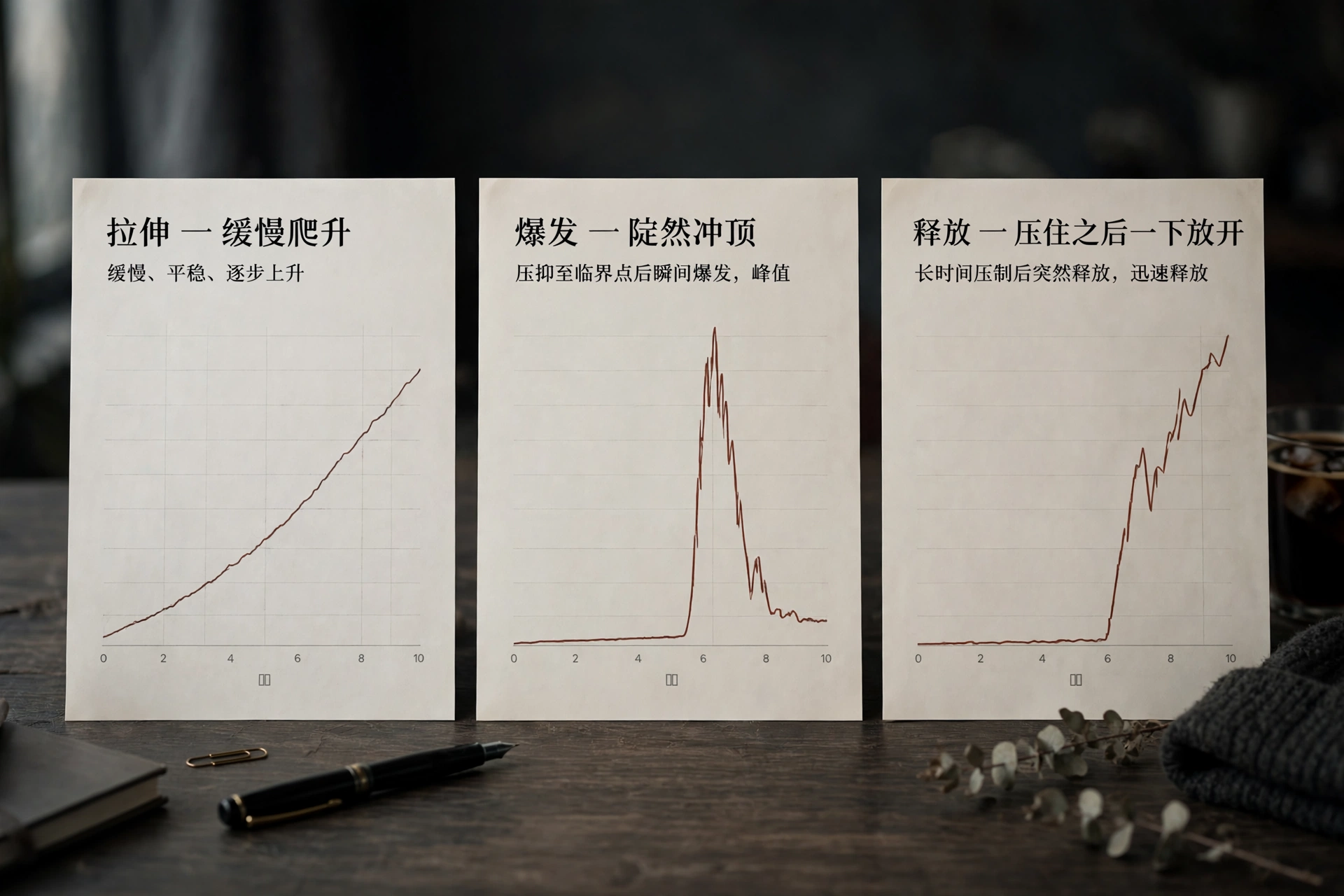
Emotion moves through time in three ways, and each formula handles one of them. Picking a formula is picking how this scene's emotion travels — once the path is set, the conflict density, the turning point and the emotional peak fall into place with it.
Emotional stretch: conflict density rises slowly from low to high, the turning point sits in the second half, and the emotional peak lands just before the end. It fits suspense, setup, and relationship scenes: the audience climbs along a little at a time and only understands at the last step. The risk is stretching it into a straight line: too long with no small turning point to rest on, and viewers leave halfway.
Emotional burst: conflict density is maxed out from the opening, the turning point comes early, and the emotional peak lands in the first third. It fits opening hooks, reversals, and conflict scenes: the audience is grabbed in the first second. The risk is having nothing after the burst: once the peak passes, if there is no new information, the rest of the time is flat ground.
Suppression and release: the first half holds the conflict down so density looks low, the turning point is the moment it can no longer be held, and the emotional peak lands at the release. It fits scenes of holding back, endurance, and a truth coming out: the quieter the first half, the harder the release hits. The risk is holding it too long: even held-down tension needs a visible crack, or viewers think nothing is happening.
How to write the prompt: write the emotional path before the timing, for example "suppression and release: hold it down for the first 10 seconds, the truth comes out in the last line." One shot, one formula — don't ask for a stretch and a burst in the same shot; the model can't serve both.
The easy mistake: putting the formula and the emotional peak out of order. When the peak is written before the turning point, the audience's feeling is already gone before they understand what happened: the turning point comes first, the peak follows it — don't reverse the order.
03 / The timeline
The timeline: write prompts along time, not still frames
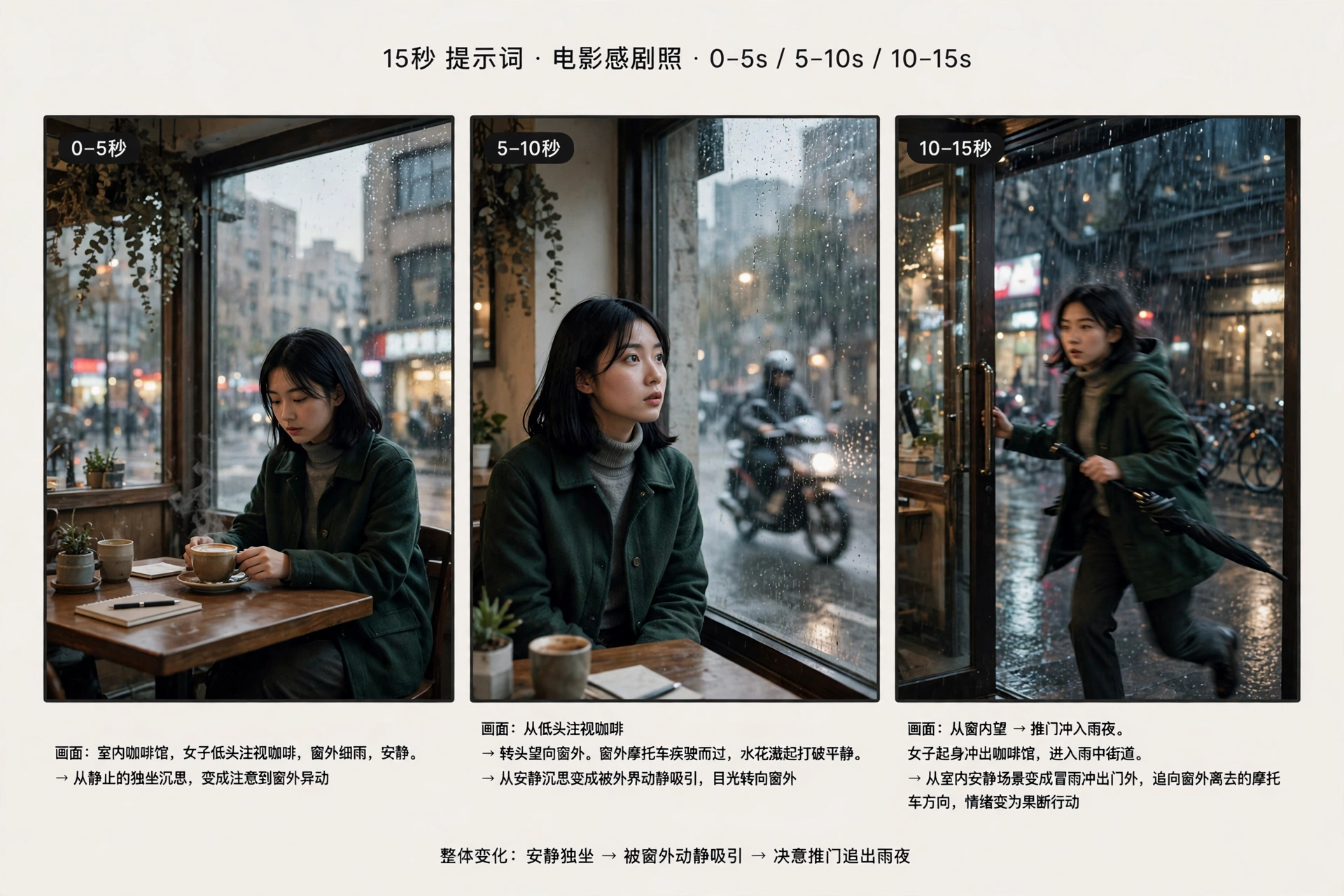
AI video is generated along time, so a prompt with no time in it defaults to a still frame with a little movement. Rhythm lives in the prompt, not only in the edit: the timeline is the prompt's skeleton.
The method is to write in blocks, each stating its start and end, what changes on screen, and how the feeling changes. Take 15 seconds as an example: 0–5 seconds hold it down — the character looks down, says nothing, music low; 5–10 seconds the crack — one small turning point, one sound effect; 10–15 seconds the release — the truth in one line, music rises, the emotional peak lands. Three blocks add up to exactly 15 seconds, and the formula, the timeline and the sound all line up.
One check before you generate: add up the blocks — they must equal the total length. A clip labelled 15 seconds whose timeline only adds up to 12, or one labelled 30 seconds whose timeline runs far past 30, will come out wrong: add it up before writing, not after a failed generation.
The easy mistake: putting two changes in one block — the model only does one of them; or writing "then" and "after that" with no seconds attached, so the model guesses the order itself, and a wrong guess scrambles the whole block. Split changes small: one action per block, seconds written down.
04 / Sound-picture sync
Sound-picture sync: where it goes wrong most
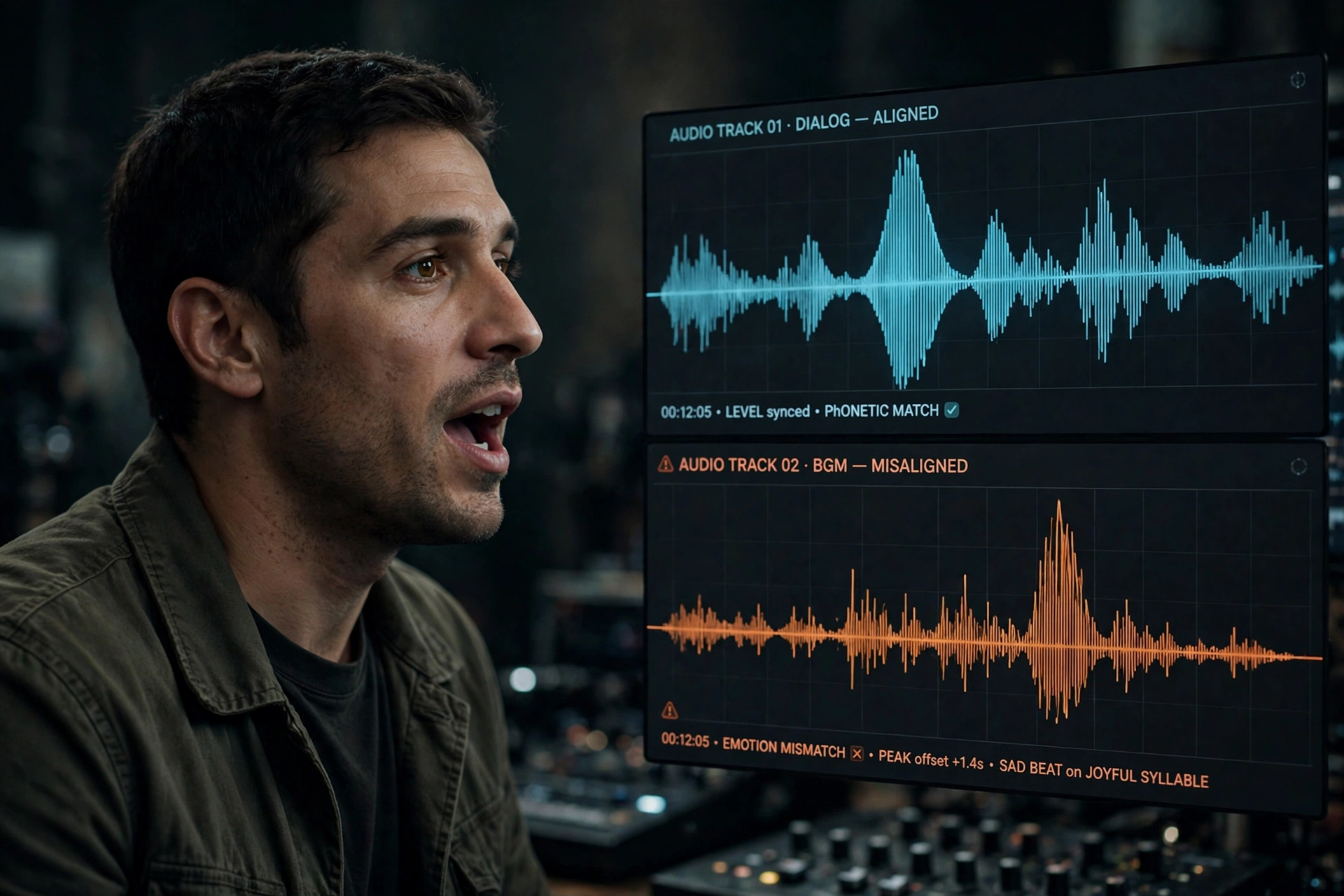
Rhythm isn't only in the picture — where the music, the sound effects and the dialogue land is rhythm too. A sound effect on the turning point, music rising on the emotional peak, and dialogue that doesn't speak before the turning point: when sound and picture land on the same point, the feeling holds.
This is also where it goes wrong most: the picture has already reached the peak while the music is still building, and the feeling leaks away; or the dialogue gives the turning point away early, so the picture's turn has nothing left in it. Picture, music and dialogue on three separate tracks means the rhythm falls apart.
Three questions to check: do the timeline blocks add up to the total length? Does every turning point have a matching change on screen? Do the music and the dialogue land on the turning points and the emotional peaks? When all three can be answered, the rhythm of this stretch is laid out right.
Walk it through once: take that 15-second suppression-and-release example. First the formula: suppression and release. Then the three numbers: conflict density low first and high later, the turning point at 10 seconds, the emotional peak at 15 seconds. The timeline in three blocks: 0–5 seconds hold it down, 5–10 seconds the crack, 10–15 seconds the release. Sound-picture sync: one effect on the crack, music rising on the release, the line of truth landing exactly at 10 seconds. Formula, timeline and sound all line up — then shoot.
At a glance
Rhythm at a glance: all three formulas
| Formula | Conflict density | Turning point | Emotional peak | Best for | Risk |
|---|---|---|---|---|---|
| Emotional stretch | Rises slowly from low to high | Second half | Just before the end | Suspense, setup, relationships | Too long, no small turning point |
| Emotional burst | Maxed out from the opening | Comes early | First third | Opening hooks, reversals, conflict | Nothing new after the burst |
| Suppression and release | Low first, high later | The moment it can't be held | The release itself | Holding back, endurance, a truth out | Held too long, no visible crack |
FAQ
Frequently asked questions
Is rhythm the same as cutting fast?
No. Fast cutting is a technique; rhythm is how information density changes over time. Over the same 15 seconds, a slow shot still has rhythm when the information is evenly laid out and the turning point lands where it should; when all the information is piled into the opening, faster cutting later can't save it.
Can the three formulas be mixed?
Yes — switching formulas inside one episode is common: a burst to grab people at the opening, a stretch to build the relationship in the middle, suppression and release to close it. The rule for mixing is one formula per shot, and the switch itself is a turning point — don't stretch and burst inside a single shot.
I wrote a timeline in the prompt and the model still gives me a still frame. What now?
Check three things: does every block say "from what to what" — a state with no change reads as a still frame to the model; are the seconds written down, because without them the model guesses the order itself; and does one block hold two changes, when the model only does one. If that still fails, split the change finer: one action per block.
The Core
The core: one formula — information divided by time
Rhythm is one formula: information divided by time. Three formulas handle how emotion moves, the timeline handles how shots are laid out, and sound-picture sync handles when the feeling lands. When all three line up, a one-minute short drama neither drags nor rushes.
Shot size, blocking, angles and rhythm are four parts of one director's language: shot size decides how far the camera is and where it cuts, blocking decides where people face, stand and move, angles decide where the camera looks and where the feeling goes, and rhythm decides how information is laid out across time. Together, the four give an AI short drama a director's touch. Next up is going overseas: the same drama, and how to change it starting from the script when the market changes.
If you're making an AI short drama or an AI commercial, rhythm is only one part of it. From breaking down the brief to storyboards, continuity and multi-version delivery, there's a director's call at every step. To talk about how your film gets made, add WeChat newwork88 or email 690076050@qq.com.
Shot sizes: how to cut AI short drama shots → Blocking: character blocking in AI short drama → Angles: 3 questions first → Moves: cinematic camera moves with AI → Drama services →
Have a project in mind? Let's talk first.
On the brief page, we can start with the type of film, scope, timeline and delivery — get clear first, then start production.