10Article · AI Short Drama Overseas 1
AI Short Drama Overseas: Market First, Script Second
The same drama in a new market isn't a new language — it's a new audience. When the audience changes, what genres people watch, what conflicts they can follow, and what feelings they can catch all have to be worked out again. The first step overseas isn't generation, it's selection: fix the market first, then measure the script against it, and only shoot once it measures up.
01 / Get this straight first
Going overseas isn't translation — it's a new audience
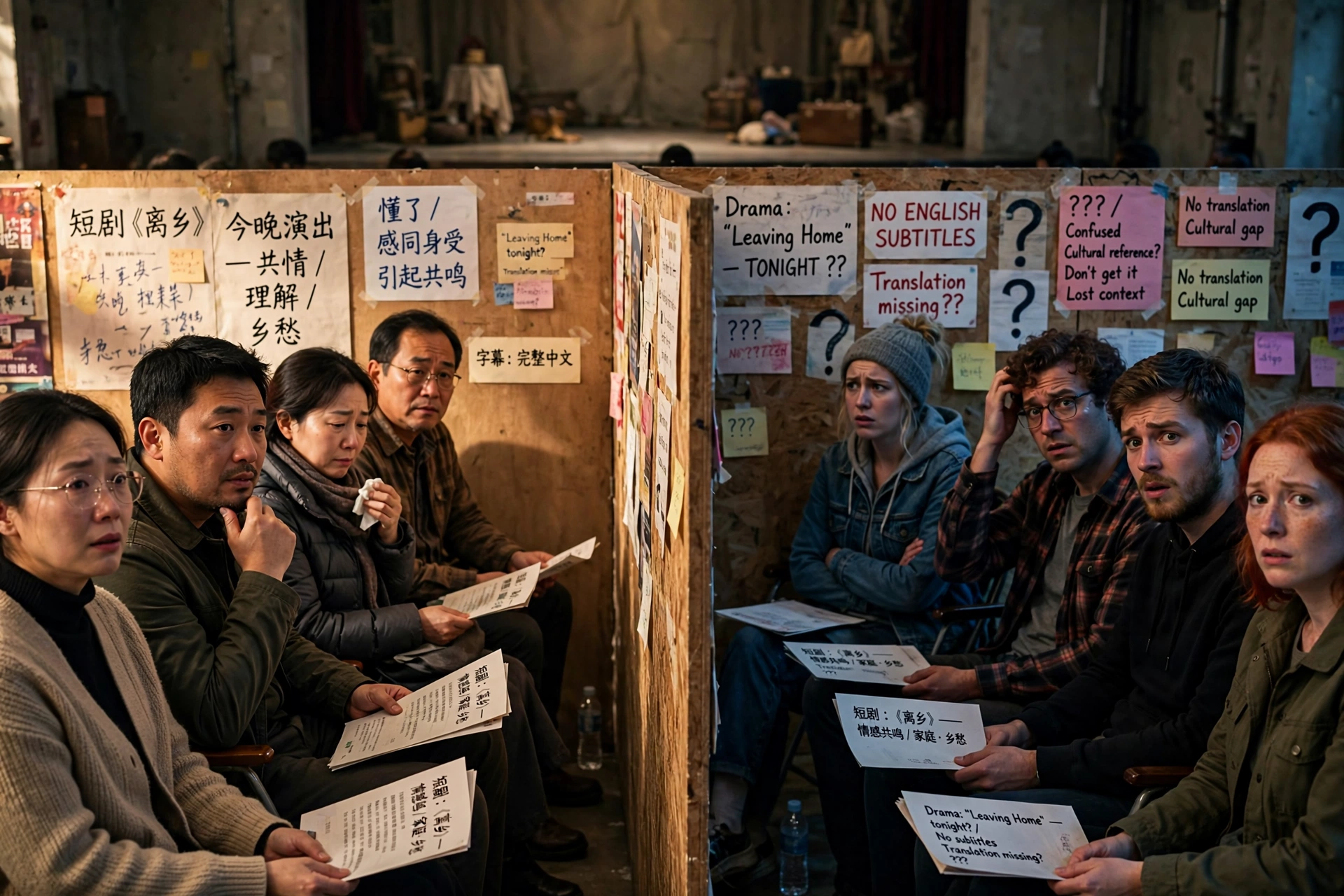
The most common way to go overseas is to finish a drama first, then translate the subtitles, swap the dubbing, and ship it out. It's the easy way, and it's also how most failures happen: the lines translate, but the joke doesn't; the plot translates, but the feeling doesn't. What the audience can't follow isn't the language — it's everything the drama assumes they already know.
A new audience means three things change: the assumed knowledge, what background and rules the drama takes for granted; the emotional entry point, the line or the scene where the audience starts to care; and the watching habit, how long an episode should run, how fast the rhythm should be, how dense the conflict should feel. Shot size, blocking, angles and rhythm — the four parts of the director's language — don't change. What changes is the audience they serve.
So the order runs backwards from what people expect: not script first and market second, but market first, then measure the script you already have against that market. Once the market is fixed, you know what has to change; before it's fixed, every change is a guess.
The easy mistake: treating overseas as one more distribution channel. The channel is the last step — picking the market, picking the script, unifying the character assets, batch generation and the edit all follow the market. Change the channel without changing the script, and you've handed the same drama to an audience that doesn't know it.
02 / Pick the market
Pick the market: three questions settle it
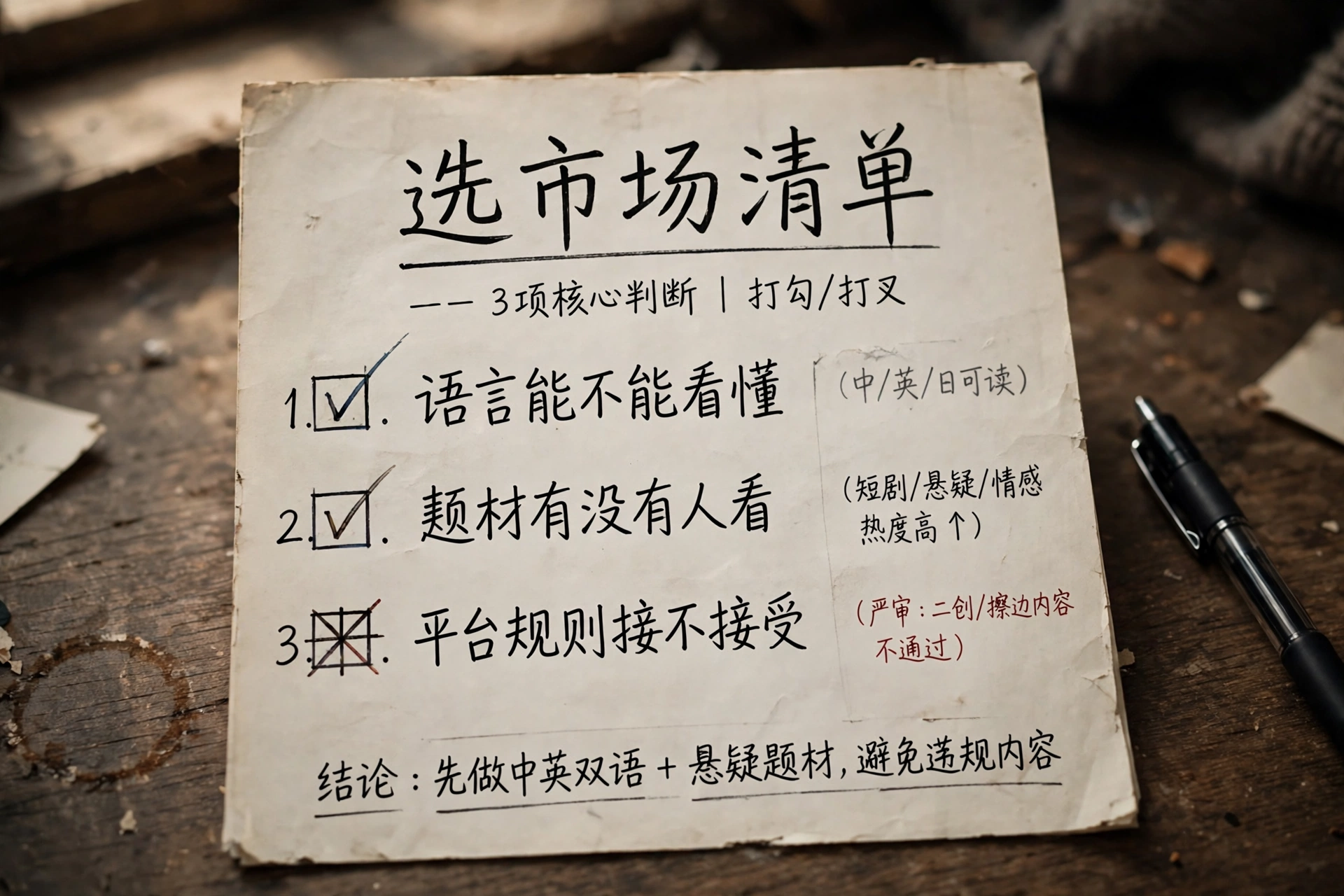
Don't be greedy with markets — fix one at a time. Before fixing it, run through three questions. When all three can be answered, the market is worth entering; when one can't, find the answer first, don't shoot first.
Question one: can the language be followed? It's not whether the subtitles translate correctly — it's how much of the hook survives translation. A hook built on wordplay, puns or allusions falls apart in translation; a hook built on images, action and reversals still stands. Scripts whose hooks run on language carry the highest cost overseas.
Question two: does anyone there watch this genre? Look at what this market is playing now and what genres people follow — start with the platform charts and the comments under similar dramas: what plot points are viewers arguing about, what characters are they heated over. If nobody watches the genre, even the best script is talking to itself.
Question three: do the platform rules accept it? Every market's platforms draw their own content lines: which genres are restricted, which images can't appear, which words can't be said. Anything in the script that crosses a line has to be screened at the market-selection step — not discovered after generation and editing, when it can't be released.
The easy mistake: looking only at how big a market is, and not at whether your script fits it. A big market with the wrong genre is a race you run as a bystander; a small market where the genre fits can run the whole pipeline through first, and that pipeline then carries to the next market.
03 / Pick the script
Pick the script: three yardsticks to measure it
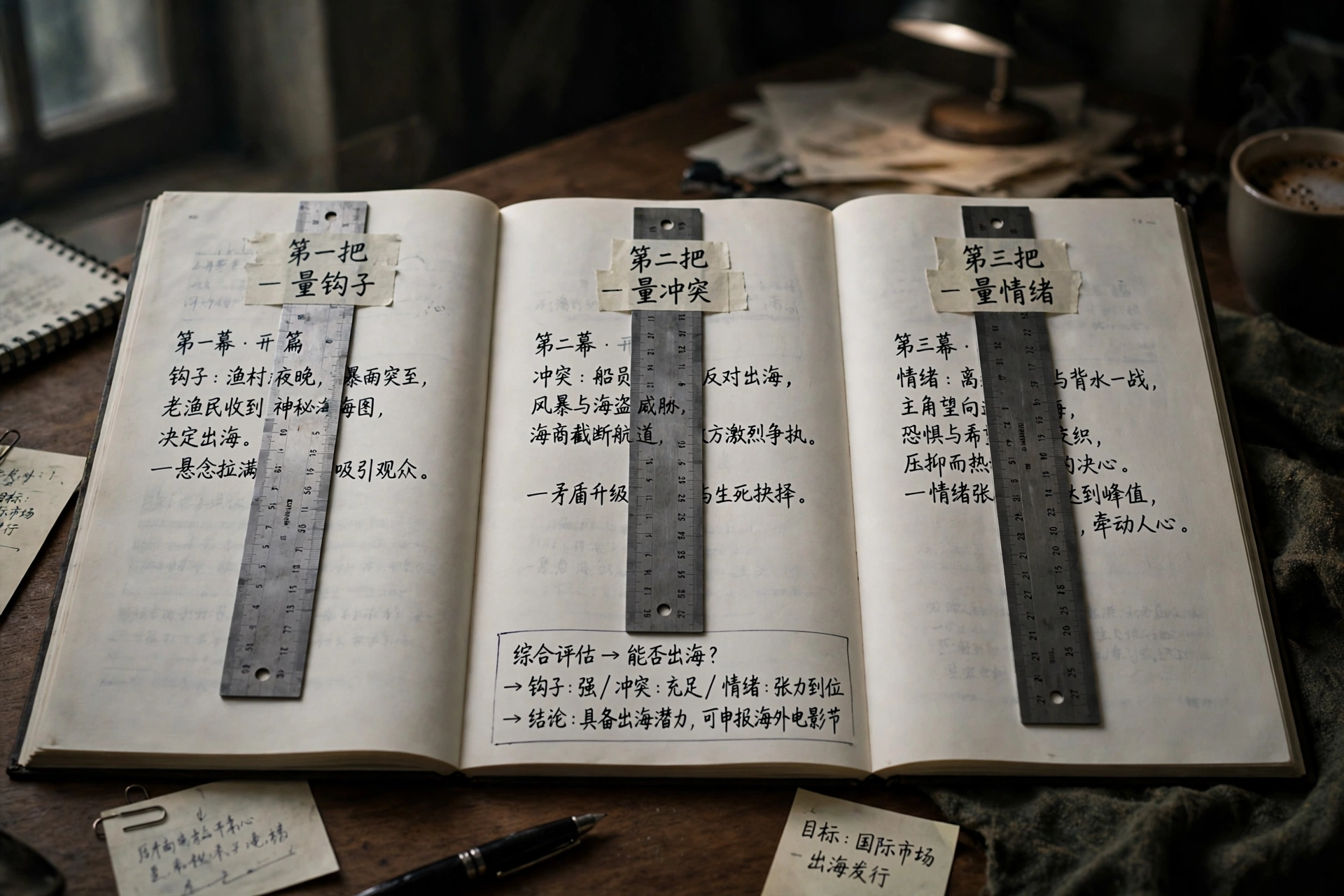
Once the market is fixed, measure the script you have. Three yardsticks, one for each place, and when the measuring is done you know whether this drama can travel and how much has to change.
Yardstick one: does the hook cross languages? Is the first-three-seconds hook a visual hook or a dialogue hook? A visual hook — someone opening a parcel with their own name on it, an unlit truck bearing down — still works in another language; a dialogue hook — a pun, an allusion — collapses in translation. When the hook collapses, the whole opening has to be rewritten.
Yardstick two: does the conflict run on dialogue? Is the conflict acted out or talked out? Acted conflict — grabbing, hiding, chasing, crashing — can be followed without understanding a word; talked conflict — negotiation, exposure, argument — runs entirely on lines, and translation discounts it until it falls apart. The heavier the dialogue, the bigger the rewrite overseas.
Yardstick three: is the feeling universal? Revenge, comeback, family, betrayal — feelings that need no explaining travel to another market and still land; feelings tied to local customs and local jokes land nowhere outside that circle. The more universal the feeling, the smaller the change; the more local the feeling, the bigger the change.
The easy mistake: measuring the plot and not the feeling. When the plot translates but the feeling doesn't, viewers remember what happened and not why they should care. Measure the feeling first: when the feeling passes, a few plot changes are enough; when it doesn't, no plot change saves it.
04 / How to adapt
How to adapt: the same drama, changed from the script up
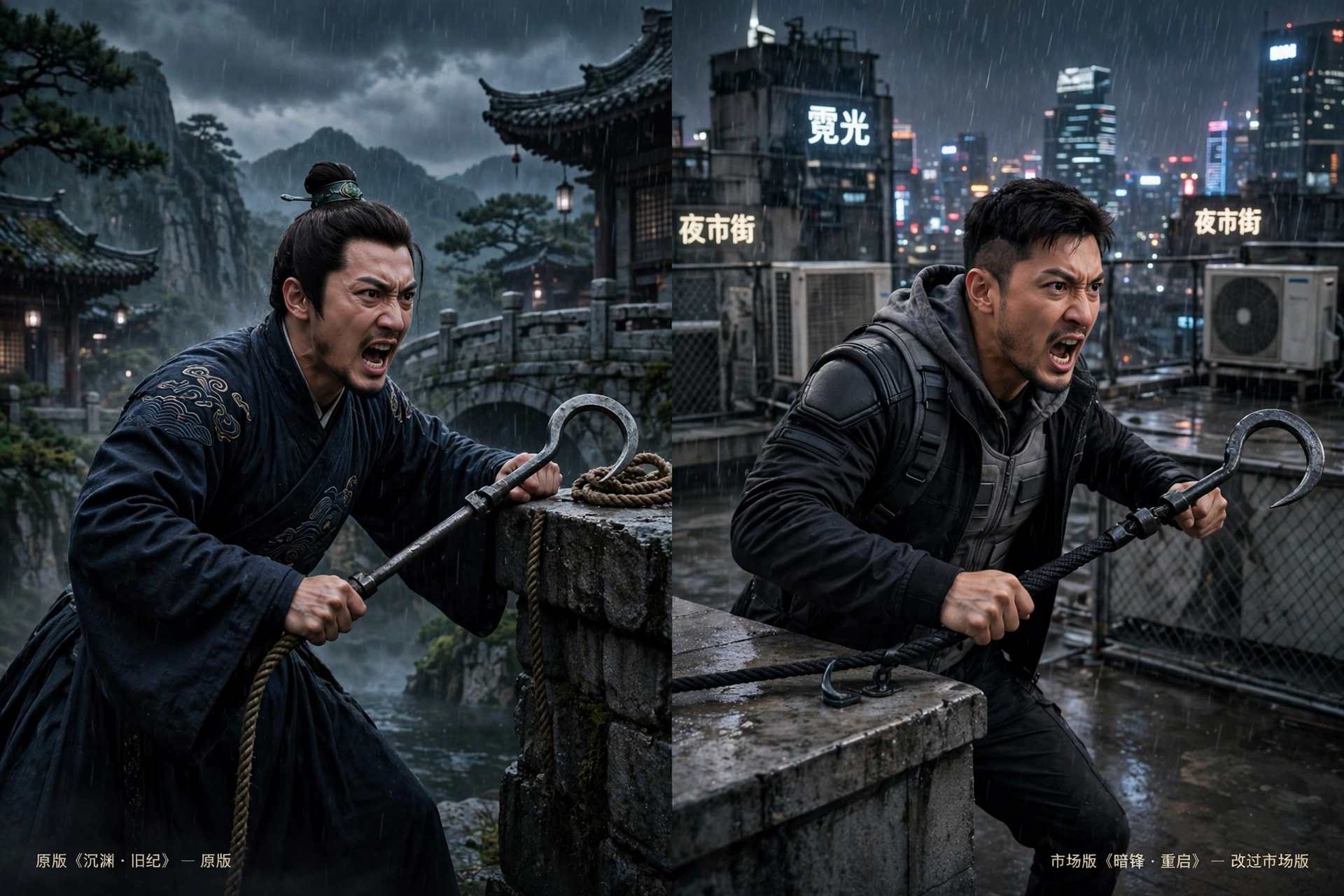
Once measured, start changing — and the order matters: change the hook and the emotional landing points first, then the surface things like names, costumes and settings. Get the hook wrong and no amount of local-looking surface helps; get the hook right and viewers will follow even when the surface is a little off.
When adapting, check back against the three questions and the three yardsticks: on language, how much of the hook survives; on genre, whether anyone in this market watches this kind of conflict; on rules, whether anything crosses a line. Then write the change list: which scenes get rewritten, which lines become images, which character names and looks change with the market.
Don't batch-generate the adapted script straight away. Run the first episode through the full pipeline first — generation, edit, dubbing, export — watch the finished episode, and confirm the hook, the conflict and the feeling all stand before going further. The first episode is the test: pass it, then scale up the investment.
Walk it through once: fix the market first and run the three questions; then measure the script with the three yardsticks; write the change list, changing the hook and the emotional landing first and the surface after; then make the first episode, run the whole pipeline, and confirm all three stand before batch generation. When the market, the script and the adaptation all line up, the drama has truly gone overseas.
At a glance
Overseas, part 1 at a glance: three questions, three yardsticks
| Step | What to ask / measure | What passing looks like | If it fails |
|---|---|---|---|
| Market: language | How much of the hook survives translation | The visual hook stands, the dialogue hook can be swapped | For a hook that runs on language, change the hook first |
| Market: genre | Does anyone there watch this genre | Charts and comments show people following similar dramas | No audience for the genre — change market or script |
| Market: rules | Do the platform content lines accept it | Nothing in the script crosses a line | Screen first — don't discover it after the edit |
| Script: hook | Does the first 3 seconds run on image or dialogue | A visual hook still works in another language | A dialogue hook collapses — rewrite the opening |
| Script: conflict | Is the conflict acted out or talked out | Acted conflict can be followed without the lines | The heavier the dialogue, the bigger the rewrite |
| Script: feeling | Is the feeling universal | Revenge, comeback, family need no explaining | Too local a feeling means bigger changes |
FAQ
Frequently asked questions
Is going overseas just translating the Chinese script?
No. Translation only solves language, not the audience: how much of the hook, the conflict and the feeling survives translation has to be measured first. Scripts carried by images and action lose little in translation; scripts carried by dialogue, wordplay and local jokes have to be rewritten.
Can one script go to several markets at once?
Yes, but don't open them all at once. Run the full pipeline through one market first — pick the market, adapt the script, make the first episode, confirm all three stand — then copy that pipeline to the next market. Open several at once and the change lists fight each other, and none of them gets done properly.
When picking a market, platform first or genre first?
Genre first, then rules. If nobody watches the genre, it doesn't matter how permissive the platform rules are; if people watch the genre but the rules won't let it through, the best script still can't be released. Both have to pass, in that order.
The Core
The core: step one overseas is picking the right market and script
Step one overseas is picking the right market and script: three questions fix the market — language, genre, rules, none of them skippable; three yardsticks measure the script — hook, conflict, feeling — and only after measuring do you know how much has to change. Once the market is fixed and the script measured, the change list writes itself, and the first episode is worth making.
Shot size, blocking, angles and rhythm are four parts of one director's language, and going overseas is working those four out again for a new audience: shot size decides how far the camera is and where it cuts, blocking decides where people face, stand and move, angles decide where the camera looks and where the feeling goes, and rhythm decides how information is laid out across time — in a new market, all four get measured again against the new audience. Next up, step two overseas: script assets — how characters, scenes and props stay unified so batch generation doesn't break faces.
If you're making an AI short drama or an AI commercial, going overseas is only one part of it. From breaking down the brief to storyboards, continuity and multi-version delivery, there's a director's call at every step. To talk about how your film gets made, add WeChat newwork88 or email 690076050@qq.com.
Shot sizes: how to cut AI short drama shots → Blocking: character blocking in AI short drama → Angles: 3 questions first → Rhythm: information divided by time → Moves: cinematic camera moves with AI → Drama services →
Have a project in mind? Let's talk first.
On the brief page, we can start with the type of film, scope, timeline and delivery — get clear first, then start production.