11Article · AI Short Drama Overseas 2
AI Short Drama Overseas: Unified Script Assets
When one drama moves to a new market, the biggest risk is not rewriting the script — it is the rewrite changing the people, the voices and the places. If the audience cannot recognise last episode's character in this episode, the drama falls apart. Step two of going overseas is not generation; it is locking the assets: character, voice, setting and props, fixed first, then generated in bulk.
01 / First, get this straight
Assets are the other half of the script
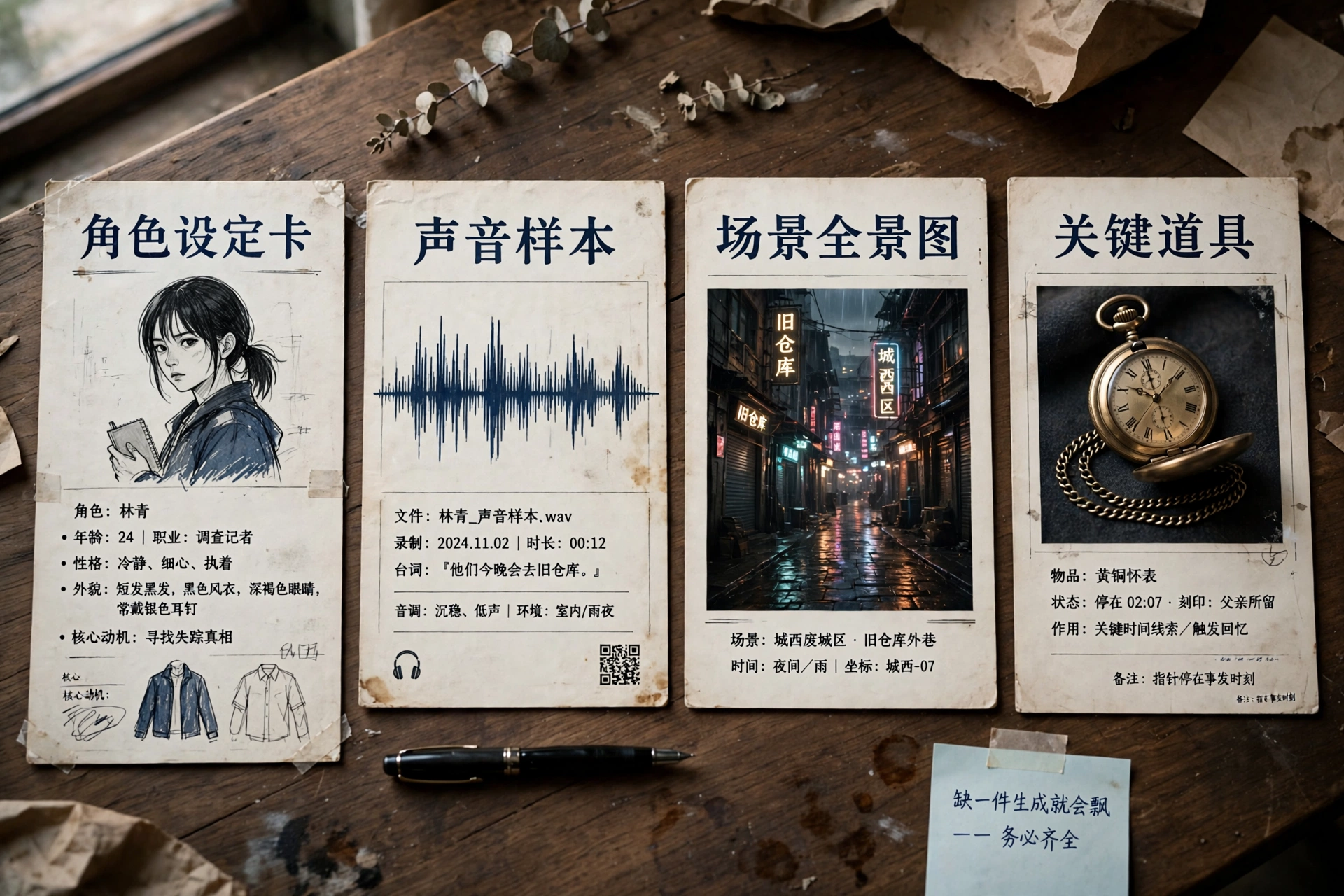
The script decides the story; the assets decide what it looks like. AI draws every shot from scratch, so without assets to hold it down, the same character gets a new face every episode and the same set gets new furniture every episode. A good script cannot stand on that. The lesson from earlier pieces is concrete: the piece on broken character consistency and the one on keeping faces from swapping are the same point — the audience recognises a person, not a name on the page.
There are four assets: character — face, build, costume, signature item; voice — tone, pace, manner of speaking; setting — place, furnishings, light; and props — the key objects that keep coming back. Miss one and generation drifts somewhere; lock all four and bulk generation is safe to scale.
Assets follow the script, never the other way round: where a character appears, what set they stand in, what prop they hold and how they speak are all in the script. Before locking assets, list every person, place and object in the script — whoever is on the list gets an asset.
The trap to avoid: locking only the lead and forgetting the supporting cast and passers-by. The lead's face holds, the supporting faces change every episode, and the audience drops out all the same. And locking only the face, not the costume and signature item — the face is right, the clothes are wrong, and nobody recognises the same person.
02 / Character
Character: one face for the whole run
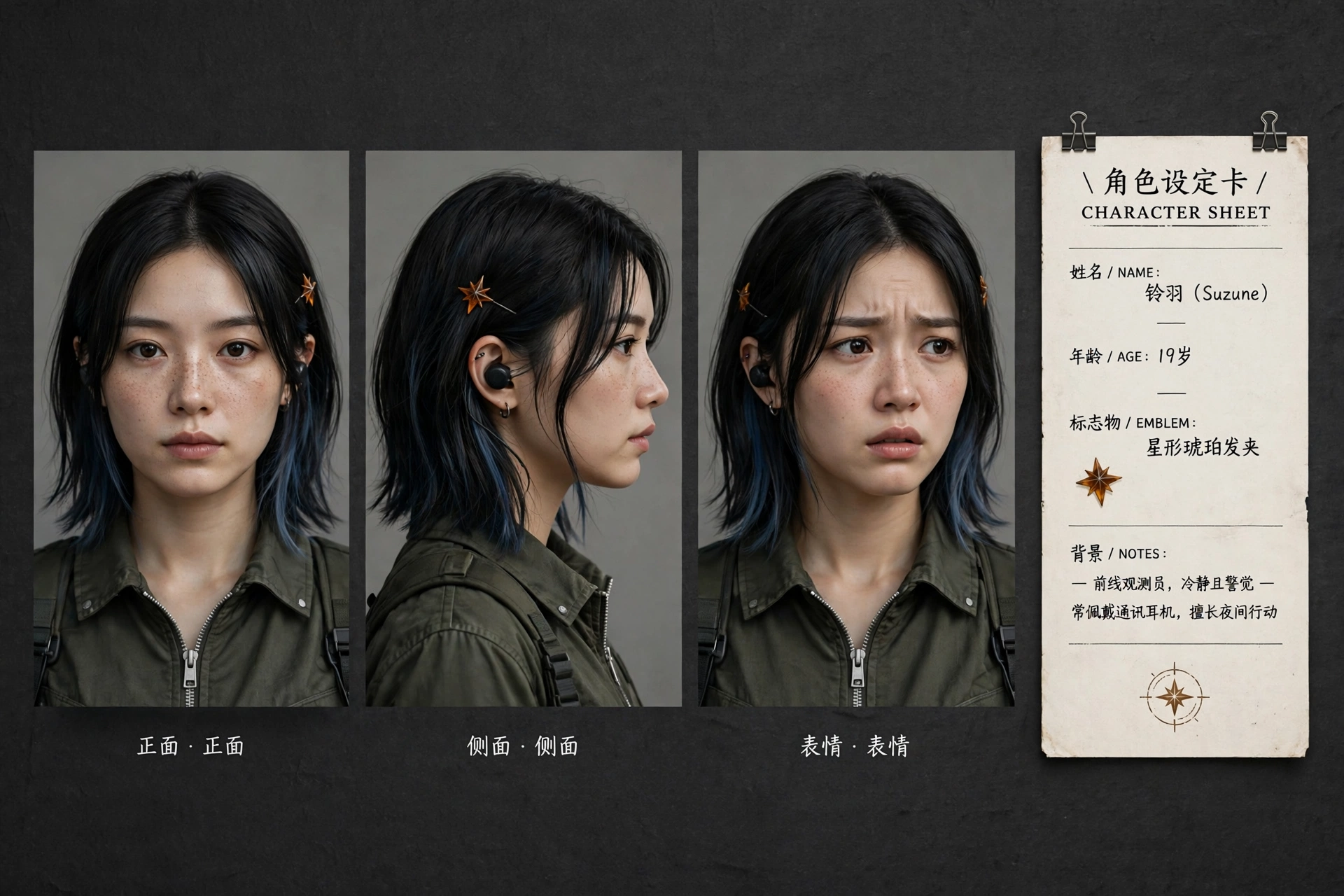
A character asset is a sheet: front, profile and expression drawings as a starting set, plus name, age, role and a signature item. The signature item matters most — a pair of glasses, a scarf, a scar. Audiences remember a person by the signature item first and the face second. Once the sheet is set, every generation uses the same sheet and the same reference images, never a fresh description.
Moving to a new market means separating what changes from what must not: name, costume and hair colour can follow the market — that is the surface. Face shape, signature item and body proportions stay — that is how people are recognised, and changing them means changing the person. The surface follows the market, the core stays the same across the whole run, so the drama does not have to start over in a new market.
Lead, supporting and background characters get different levels of detail: the lead gets the full set — reference drawings, expression sheets, written notes; the supporting cast gets face and costume locked; background characters can get costume and silhouette only, no sheet each. Spend the detail where the screen time is; do not spread it evenly.
The trap to avoid: rewriting the character description every episode. Change one descriptive word and the face drifts a little; ten episodes later it is not the same person. Use the same sheet all the way through, not one changed word — whatever changes stays outside the sheet.
03 / Voice
Voice: one person behind the mic all the way
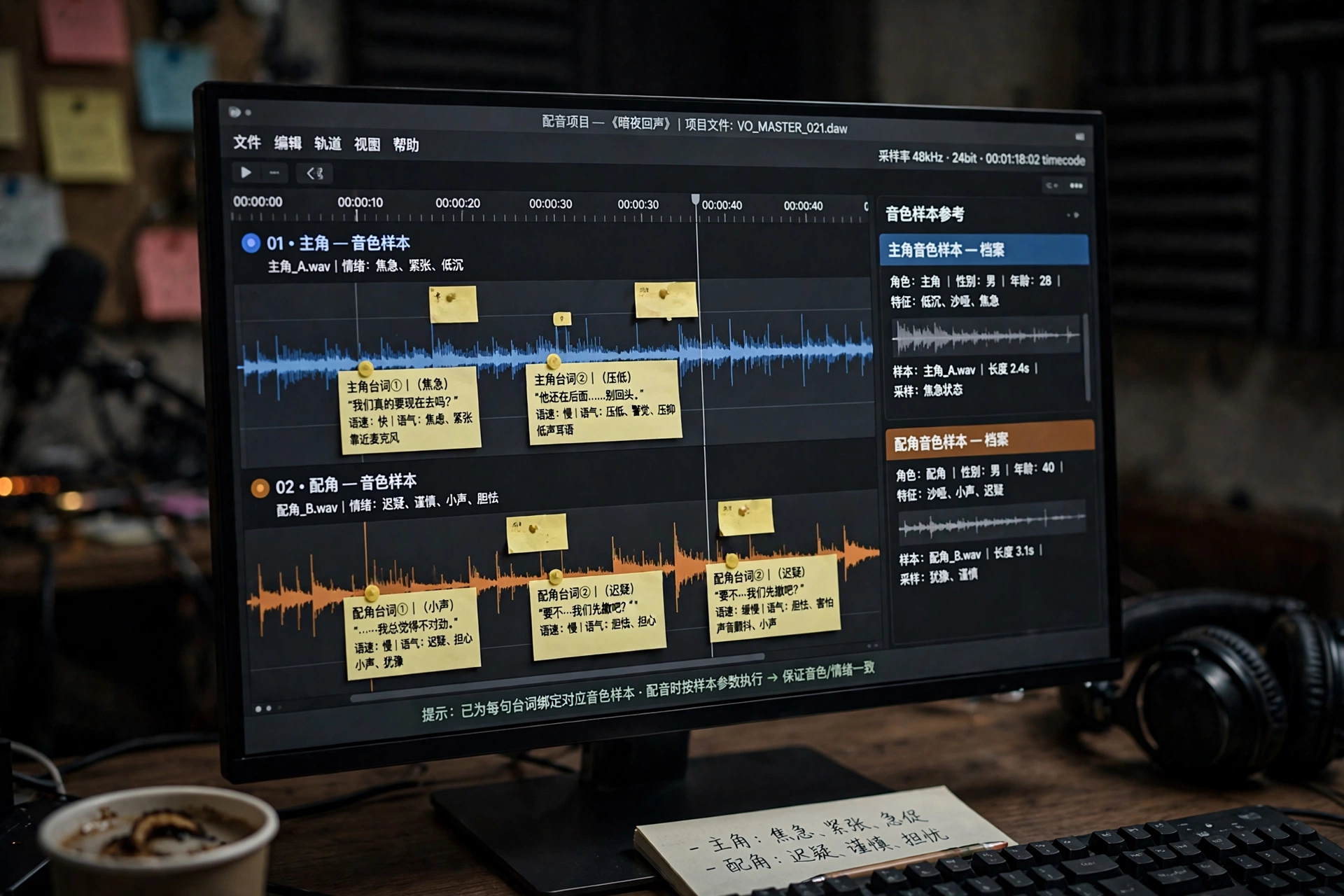
Voice is an asset, and the one most often forgotten. Fix a tone sample for the lead first — tone, pace, manner of speaking, written on a voice card — and match every line to that sample, however many lines there are. Give each supporting character their own sample; never let several characters share one voice. The audience should know who is speaking with their eyes closed.
A new market means a new language, so the dub has to change — but the quality of the voice has to match: a steady character given a shrill voice collapses the role; a restless character read slowly lets the conflict go slack. Adjust accent and pace to how the local audience listens; do not translate the Chinese pace word for word.
Voice and face have to match each other: a cold face should not get a warm voice, and a thirty-year-old courier who has ridden deliveries for five years should sound like that age and that tiredness. When face and voice go their separate ways, the audience's first reaction is that this is not the same person.
The trap to avoid: minding the picture and ignoring the voice. The face holds, the voice swaps, and the audience still feels someone was replaced. Before dubbing, list the voice cards — who voices whom, what tone, what pace, one card per person — and check the finished dub against the cards.
04 / Setting and props
Setting and props: steady even in a new market

A setting asset is one wide reference of the main set: place, furnishings, signage, light, season — fixed. A drama has only a few main sets — a street in the old town at night, a convenience-store doorway — and every episode changes camera position inside the set it already has instead of inventing a new one. Camera positions can be free; the set cannot.
Props get their own file, especially the key props that keep returning: shape, colour, size, how they appear — fixed. A new market can change the words on the packaging, but not the prop itself: the audience follows the plot through the props, and if a prop changes, the hook planted earlier breaks.
When a set follows the market, only the surface changes: signage text, street-side furnishings, goods on a shop shelf can be localised; the skeleton of the set — which way the street runs, where the shop door sits, where the light comes from — stays. Move the skeleton and the sense of space built in earlier episodes is gone.
Putting it together: before shooting, list the assets — character, voice, setting, props, all four ready before the camera rolls. The lead gets the full sheet, the supporting cast gets face and costume locked, background characters get costume and silhouette only. A new market changes the surface; face, signature item and the skeleton of the set do not move. With assets locked, generation can run in bulk without swapping faces.
At a glance
Overseas 2 at a glance: four assets in one view
| Asset | What to lock | What passing looks like | If it fails |
|---|---|---|---|
| Character | Front, profile and expression sheets; name, signature item | The same sheet all the way through — the same person in episode ten | Rewriting the description each episode: switch to one sheet |
| Voice | Tone, pace and manner samples, one card per person | Known by voice alone, eyes closed | Several characters sharing one voice: give each a sample |
| Setting | Wide reference of the main set; furnishings and light fixed | Camera moves, set does not — day and night, the same place | Set following a feeling: lock the wide shot before shooting |
| Props | Key prop shape, colour, size, how it appears | A new market changes the packaging words, not the prop | Prop changing every episode: file it separately and fix it |
Pre-shoot checklist
Before shooting, run the checklist
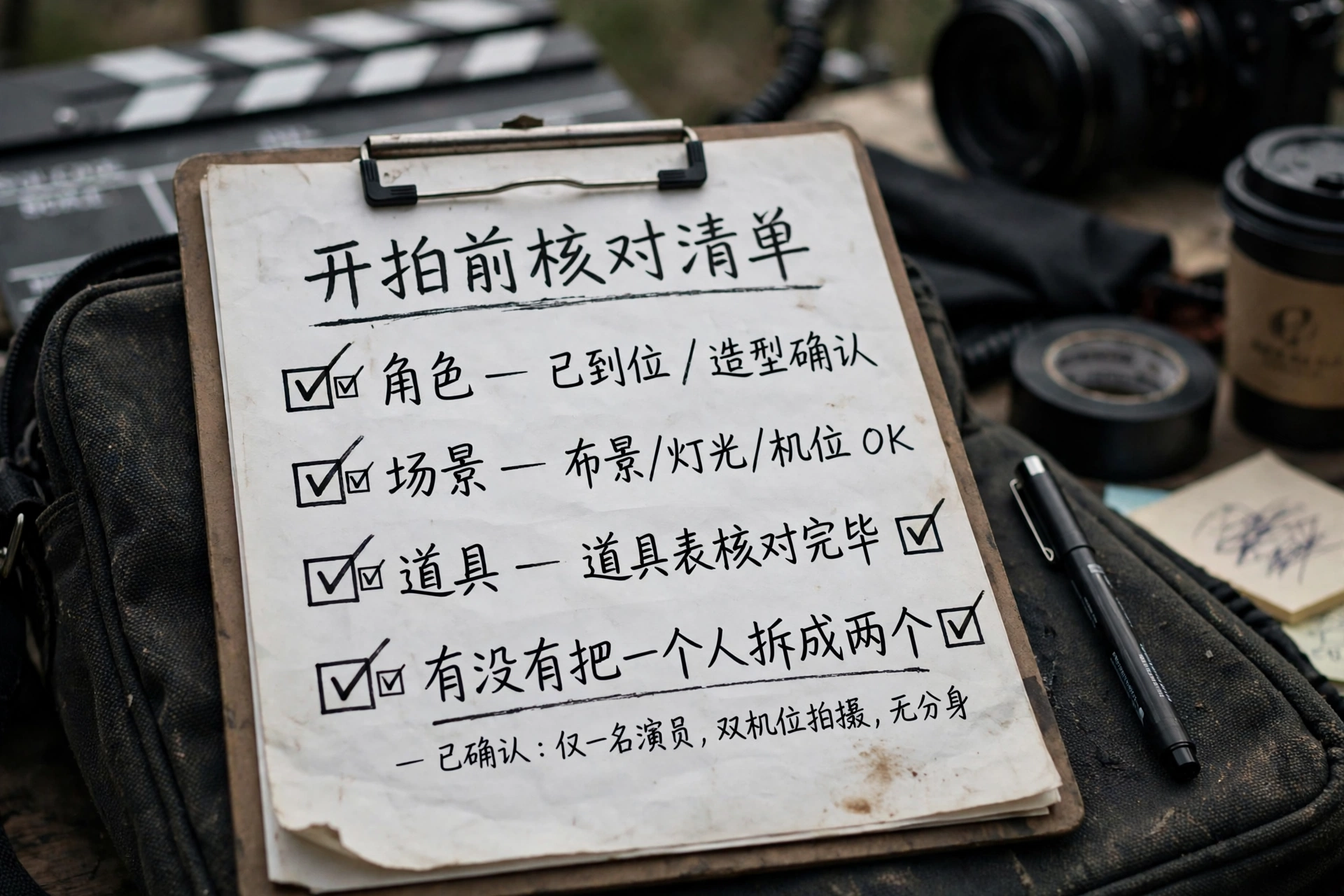
Assets locked, then one more pass over the checklist before the camera rolls — do not shoot with anything missing: are character, setting and props all ready; has one person been split into two — the same character under two names or two faces on two sheets; do the names match what the dialogue calls them, is the person in the lines the same person on the sheet?
The checklist stays short, four questions: are the people ready, is the place fixed, are the objects right, are the voices told apart? If any answer is no, go back and fill in the asset — do not gamble on generation. Generation can fill a frame; it cannot fill a missing asset.
The same list is the acceptance check: after each batch of generation, spot-check against the sheets — face swapped, voice swapped, set swapped — and regenerate on the spot instead of finding out in the edit. Assets are the floor, spot-checks are the insurance; with both, bulk generation holds steady.
FAQ
FAQ
How detailed should assets be?
Detailed enough that someone else could generate the same person from your sheet: face, costume, signature item, voice sample, wide shot of the set — miss one and something can swap. The lead gets the most detail, the supporting cast less, background characters costume and silhouette only; detail follows screen time.
Does a new market mean rebuilding the assets?
No — change the surface: name, costume, accent and signage text follow the market; face, signature item and the skeleton of the set stay. Most of the asset work is done once; a new market changes a small part of it.
With assets locked, can faces still swap in generation?
Far less, but not zero. Assets are a floor, not a guarantee: spot-check each batch against the sheets and regenerate swaps on the spot instead of finding out in the edit. Locking assets plus spot-checks is what keeps face-swapping down.
Core point
Core point: step two of going overseas is locking the assets
Step two of going overseas is locking the assets: one face for the character all the way through, one voice for the role all the way through, and sets and props that stay steady in a new market. With assets locked, bulk generation can scale; without them, the more you generate, the more swaps.
Picking the market and the script was step one; unifying the assets is step two. Once all four assets — character, voice, setting, props — are locked, generation is next. The next piece covers step three: generation, editing and publishing — how a drama with locked assets gets made in bulk, cut and released.
If you are making AI short dramas or AI commercials, going overseas is one part of it. From breaking down a brief to storyboards, continuity control and multi-version delivery, every step needs a director's eye. To talk about how your film gets made, add WeChat newwork88 or email 690076050@qq.com.
Overseas 1: Market First, Script Second → Shot Sizes in AI Short Drama: One Formula → Character Blocking in AI Short Drama → Camera Angles in AI Short Drama: 3 Questions First → Rhythm in AI Short Drama: Information Divided by Time → Cinematic Camera Moves with AI: 4 Moves, Explained → Drama Services →
Have a project in mind? Let's talk first.
On the brief page, we can start with the type of film, scope, timeline and delivery — get clear first, then start production.