12Article · AI Short Drama Overseas 3
AI Short Drama Overseas: Generate, Cut, Publish
Market picked, script adapted, assets locked — only then does step three start: generation. But generation is not the end of the job. Editing and publishing still follow, and if those two cannot keep up, however much you generate never reaches an audience. Step three is running the whole line: take episode one through generation, editing and publishing first, and only scale up once it runs clean.
01 / First, get this straight
Generation is the start of the line, not the end
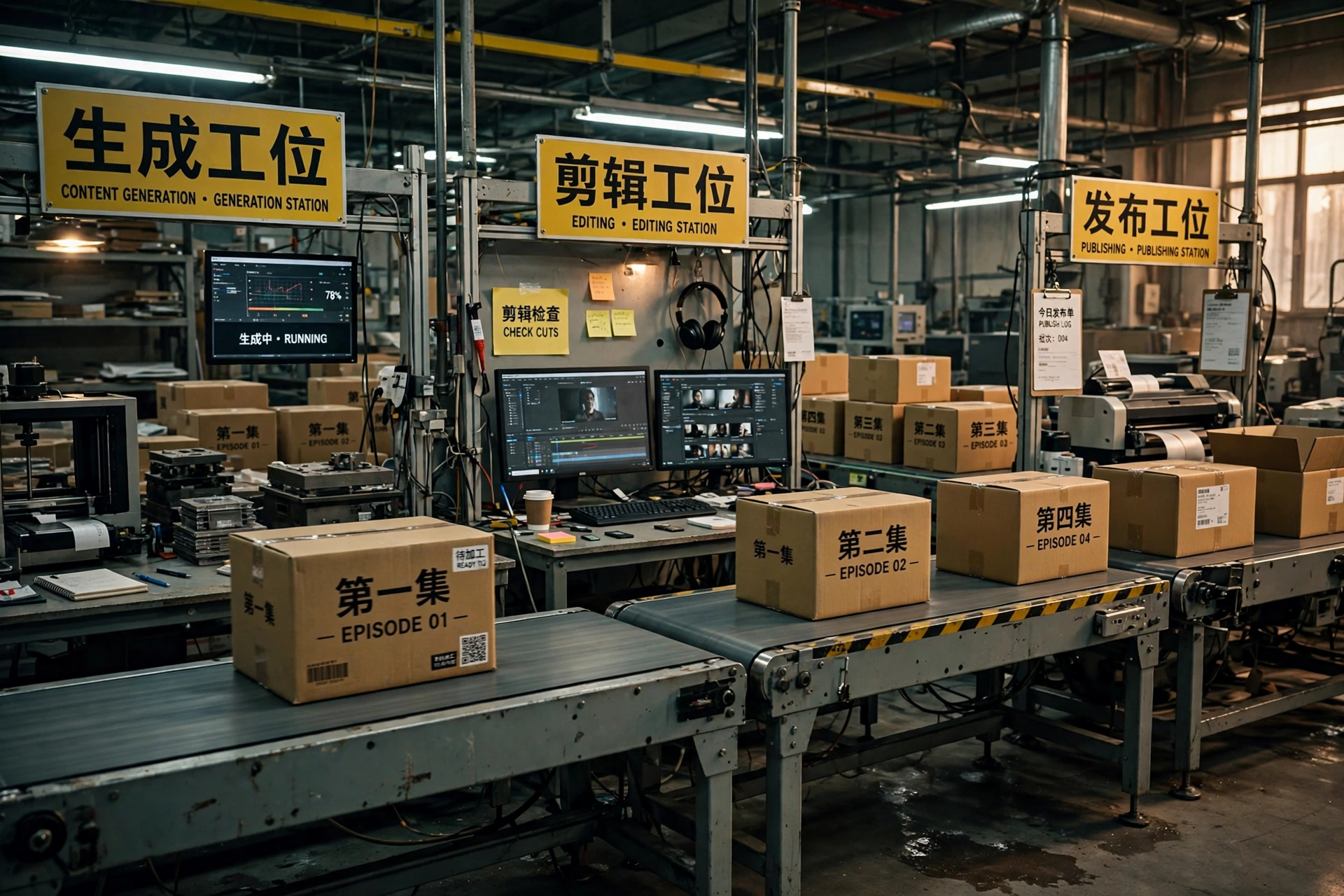
Locked assets do not mean a drama can be produced in bulk. Generation, editing and publishing are three gates, and episode one is the test: run the whole line on episode one first, and fix whichever step jams there — do not wait until ten episodes are generated to find out the cut will not work or nothing can be released.
Do not run the order backwards: make one complete episode first, then generate in bulk; cut one releasable version first, then fix the release rhythm; release a small amount first and watch the response, then decide whether to scale. Run it backwards and the more you generate, the more rework costs — one change becomes ten episodes to fix.
Leave a checkpoint at every step: generation checks whether the assets hold, editing checks whether the rhythm flows, publishing checks whether the audience stays. A checkpoint is not a formality — it is the switch that decides whether the next step happens at all, and how much of it. If the step before it has not passed, do not rush into the next one.
The trap to avoid: treating generation as the finish line. Once the shots are generated, the drama feels done — until editing finds the rhythm off and the hook buried too late, and publishing finds the subtitles and dubbing were never split by market. Generation is only the start; editing and publishing are where a drama becomes fit to be seen.
02 / Generation
Generation: run episode one clean, then batch
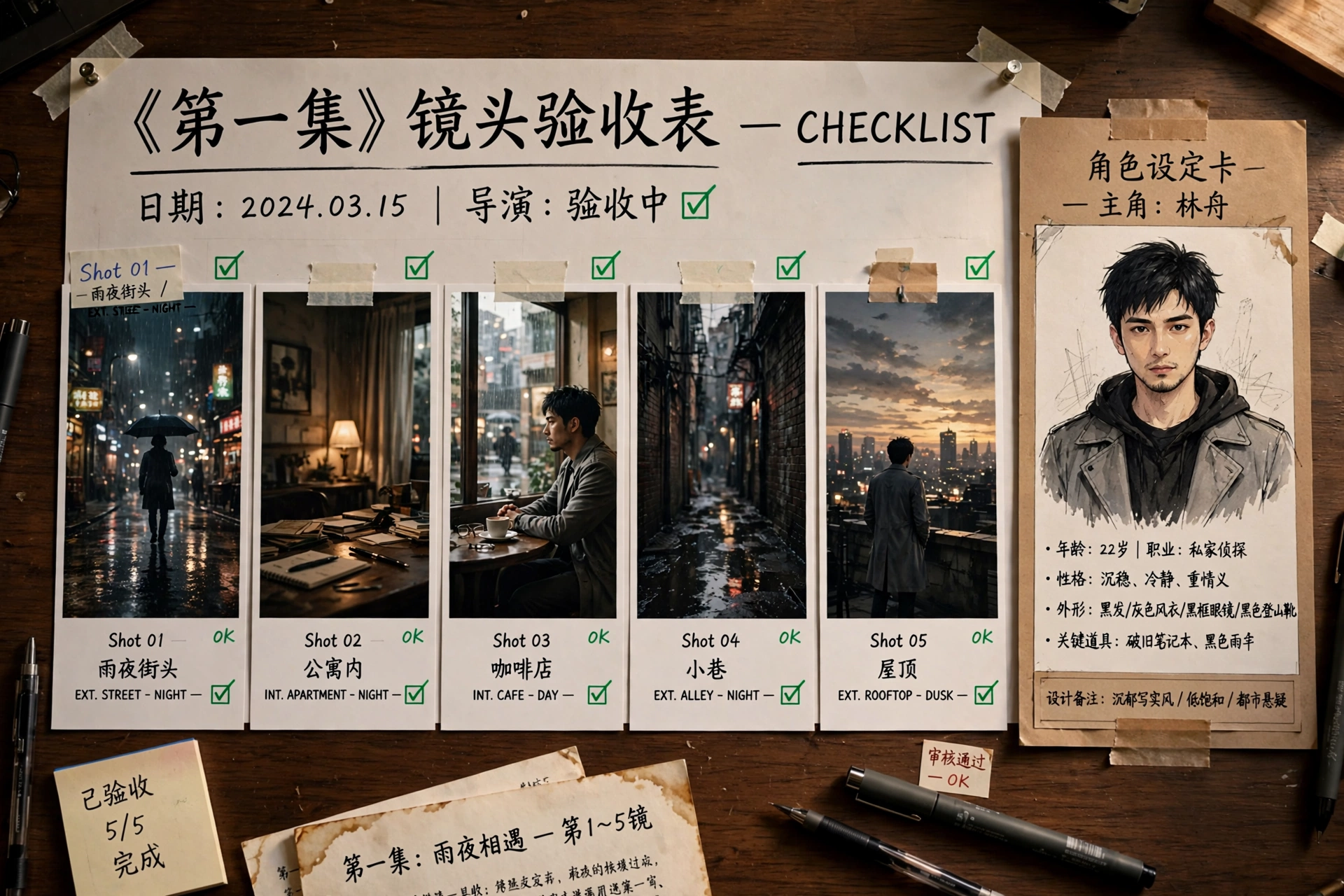
Generate episode by episode, not the whole drama in one order. Generate episode one complete first: face, voice, setting and rhythm all right, then open episode two. Batch-generate before episode one runs clean, and the same mistake gets copied ten times — the bigger the batch, the neater the error.
Spot-check each episode as it is generated, against the asset sheet from Overseas 2: has the face swapped, has the voice swapped, has the set swapped, do the lines match the mouth? Regenerate swaps on the spot instead of saving them for the edit — a problem found on the cutting table means fixing a whole finished episode, at double the cost.
Batch generation still needs slack: generate a few spare takes for the key shots in each episode and use the best one, instead of generating one single path with no alternative. Spare shots are room for the editor — when a shot's rhythm feels wrong in the cut, a spare can replace it; with no spare, the only fix is generating again.
The trap to avoid: generating everything at once. It looks efficient to generate all ten episodes in one go, until the flaw in episode one turns up in all ten, and one fix becomes ten fixes. Slow on episode one, fast on the next nine — that is how the maths works.
03 / Editing
Editing: the edit is directing a second time
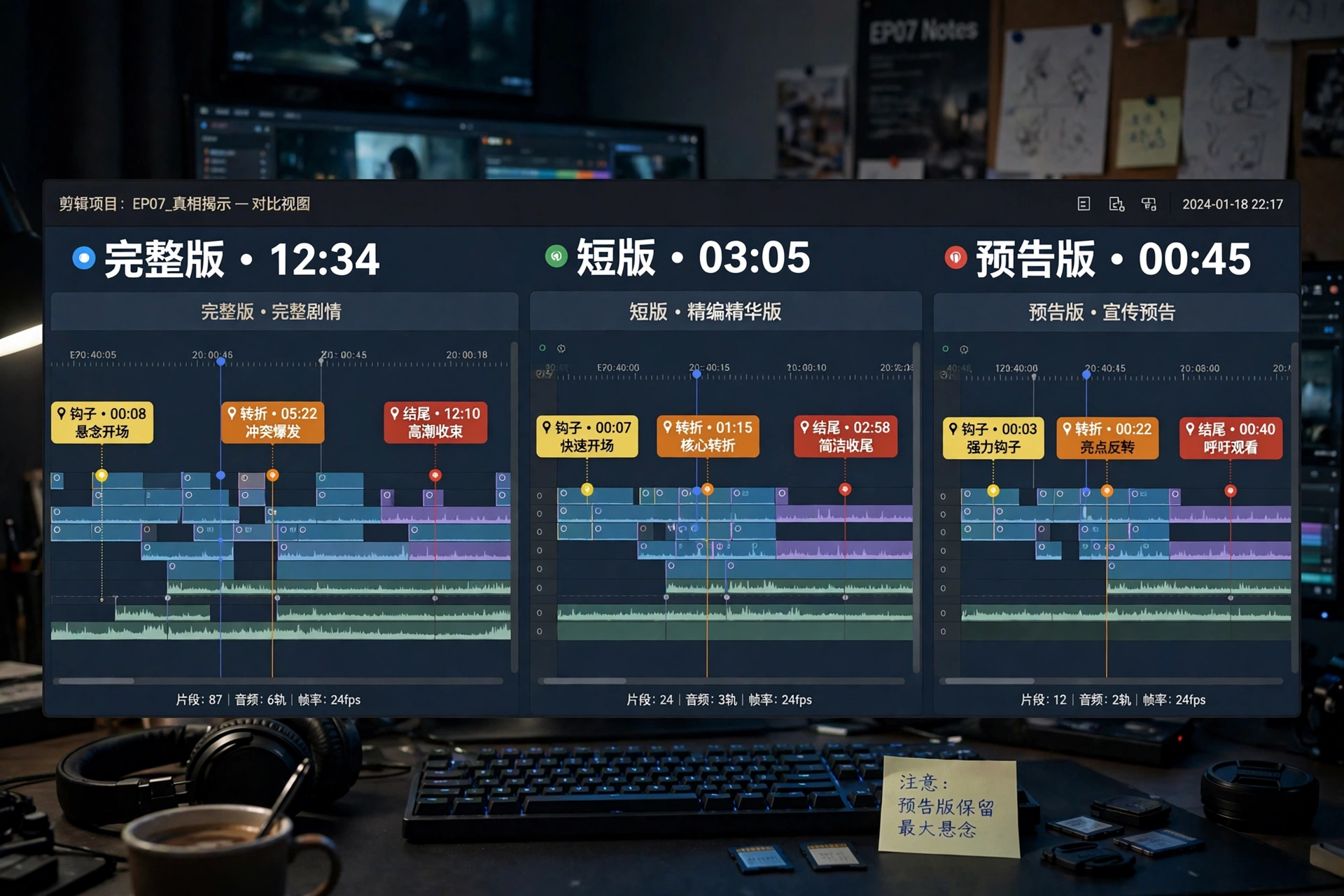
Editing is not joining the generated shots together, it is reordering by rhythm: hook first, information laid out the way the rhythm piece lays it out, turn and ending landing where they should. Generation decides what the shots look like; editing decides what the audience sees first and what comes after.
Cut several versions from one episode: a full version, a short version and a teaser, each for a different use. Different markets have different rhythm, subtitles and dubbing, so the edit follows the market: hook position, pace, subtitles and dubbing adjust by market, while the skeleton of the story stays — only the telling changes.
Check the assets once more on the cutting table: face, voice and setting, looked at again, and any swapped shot replaced with a spare instead of cut in as it is. Editing is the last gate that can catch a swapped face; if it does not, the audience spots it in the finished piece at a glance.
Putting it together: generate one episode, check it, cut it, check it again, and only move to the next episode once a releasable version exists. Every episode is a small loop — generate, check, cut, check — and once the loop runs smoothly, batch production holds steady.
04 / Publishing
Publishing: test small, then scale

Publishing is not releasing the whole drama at once. Release episode one first and watch where viewers get to, where they stay, and what the comments ask. If the numbers are weak, fix first: a weak hook means fixing the hook, a weak rhythm means fixing the edit, swapped generation means regenerating those shots. Fix, then release episode two — do not send later episodes into the same problem.
Keep the release rhythm fixed: once episode one holds, release the rest on a steady rhythm. A gap hurts more than a delay — when viewers do not know when to come back, they stop coming back. A fixed rhythm also gives generation and editing a clear delivery date, and that is what keeps the whole line moving.
Release each market separately: subtitles, dubbing, title and cover made per market, never one version sent everywhere. Markets differ, so the first thing a viewer sees differs too — the same cover and the same title will not necessarily work in a new market.
The trap to avoid: releasing everything once it is generated. Ten episodes out at once, and the numbers cannot say which episode is the problem, leaving nowhere to start fixing. Release one, watch one, fix one — that is how the numbers tell you what to change next.
At a glance
Overseas 3 at a glance: generation, editing, publishing in one view
| Step | How | What passing looks like | If it fails |
|---|---|---|---|
| Generation | Run episode one through the whole line first, then generate episode by episode | Face, voice, setting and rhythm all match the asset sheet | Batching before episode one runs clean: stop and fix episode one first |
| Editing | Hook first; cut a full version, a short version and a teaser from one episode | Rhythm flows, versions are distinct, swapped shots replaced with spares | Rhythm off, hook buried too late: reorder, do not regenerate |
| Publishing | Release episode one and read the numbers, then scale on a fixed rhythm | You know where viewers stay and what the comments ask | Releasing everything with weak numbers: stop, fix that step, then release |
| Checkpoints | A checkpoint at every step: generation, editing and publishing each checked once | No step starts until the one before it has passed | Checkpoints treated as a formality: write them into the workflow and run it again |
Pre-release checklist
Before release, run the checklist
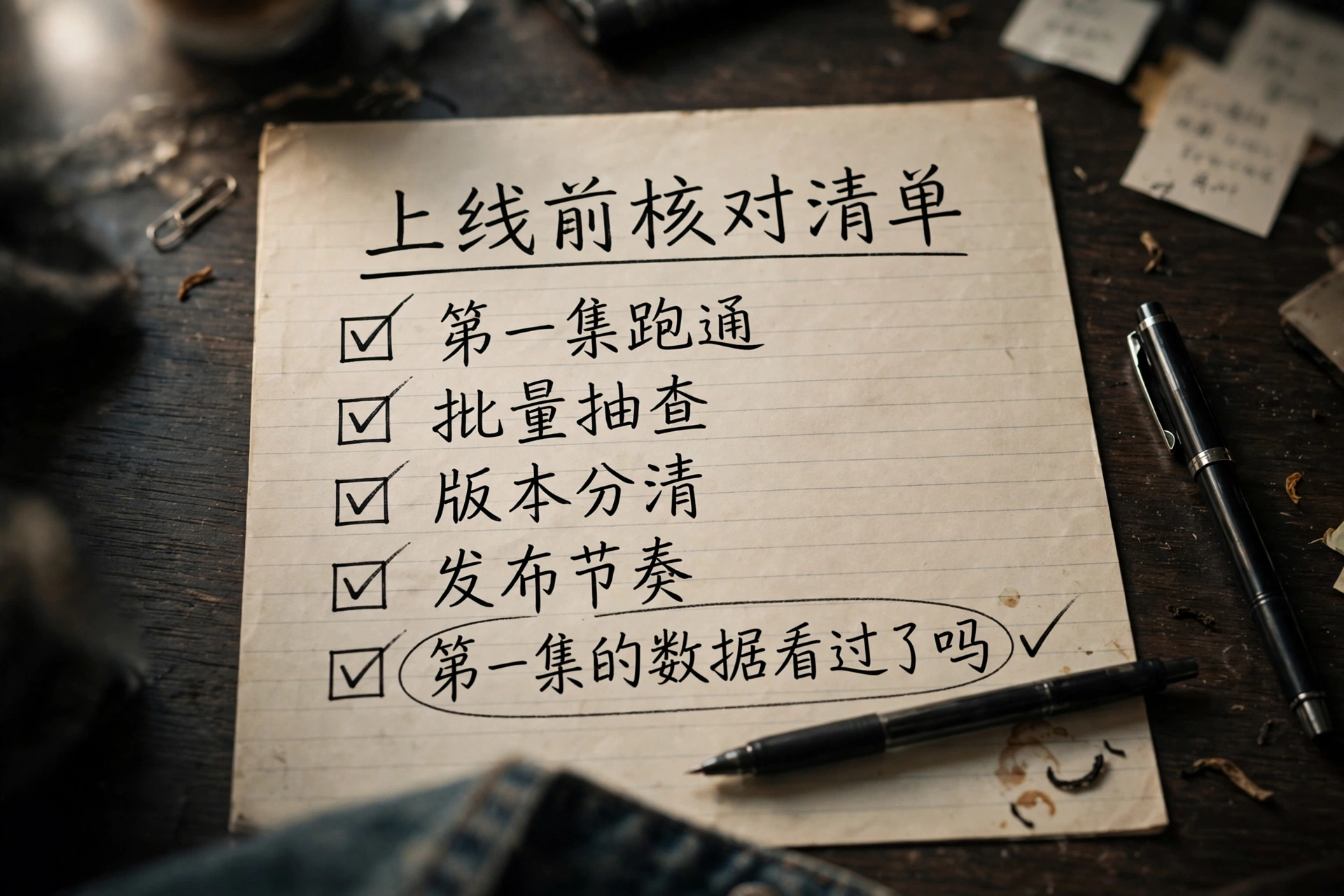
Once the whole line has run, go over the checklist before release — do not release with anything missing: has episode one run through the full line, were the batches spot-checked episode by episode, are the edited versions split by market, is the release rhythm fixed?
The checklist stays short, four questions: does episode one run clean, does the batch hold, are the versions distinct, is the rhythm fixed? If any answer is no, go back and fill in that step — do not gamble on the release. What goes out cannot be taken back, and fixing it after release costs far more than generating it.
The same list is for review: after each episode goes out, look back at the numbers and note which step jammed and how to avoid it next time. Across seven pieces, the method is all in this list: pick the market, pick the script, lock the assets, run the line — miss one step and going overseas loses a measure of certainty.
FAQ
FAQ
How many episodes should be generated at once?
Run one episode through the full line first, then generate in batches, spot-checking each batch against the asset sheet. Before episode one runs clean, do not generate a single extra episode; after it runs clean, a batch of several episodes is fine, as long as the checks keep up.
Does each market need a fresh edit?
No reshoot — a re-edit is enough: hook position, pace, subtitles and dubbing adjust by market, while the story skeleton stays. Generation happens once, editing splits by market — that is where multi-version delivery saves its money.
What if the numbers are weak after release?
Find which step it is first: viewers leaving at the start means fixing the hook and the edit; viewers dropping off in the middle means fixing the rhythm; swapped faces and voices mean regenerating those shots. Fix that step, not the whole drama — and release the next episode only after the fix, so the same problem does not hit two episodes in a row.
Core point
Core point: step three of going overseas is running the whole line
Step three of going overseas is running the whole line: test the full pipeline on episode one, check generation episode by episode, cut by version, and read the numbers before scaling. Once the line runs, bulk production is safe to scale; before it runs, the more you generate, the more rework costs.
The seven pieces close here: shot size, blocking, angles and rhythm are the four parts of a director's language, and Overseas 1 picking the market and script, 2 locking the assets, and 3 running generation, editing and publishing are the three steps that carry that language into a new market. The method is all in these seven pieces — what remains is to take one drama and walk it through in this order.
If you are making AI short dramas or AI commercials, going overseas is one part of it. From breaking down a brief to storyboards, continuity control and multi-version delivery, every step needs a director's eye. To talk about how your film gets made, add WeChat newwork88 or email 690076050@qq.com.
Overseas 2: Unified Script Assets → Overseas 1: Market First, Script Second → Shot Sizes in AI Short Drama: One Formula → Character Blocking in AI Short Drama → Camera Angles in AI Short Drama: 3 Questions First → Rhythm in AI Short Drama: Information Divided by Time → Drama Services →
Have a project in mind? Let's talk first.
On the brief page, we can start with the type of film, scope, timeline and delivery — get clear first, then start production.