13Article · AI Short Drama Follow-up
Pre-Shoot Check: Nothing Missing, Nothing Doubled
The most expensive mistake in an AI short drama does not happen at generation time. It happens before the shoot: a character never locked, a set with no reference image, a prop that appears three times in the script and never once in the asset list. Generation can be re-run. Missing or doubled assets cannot be fixed by re-running. Ten minutes with a checklist before the shoot costs far less than reworking ten episodes after it.
01 / Think First
The Checklist Is Not a Formality. It Is the Last Gate.
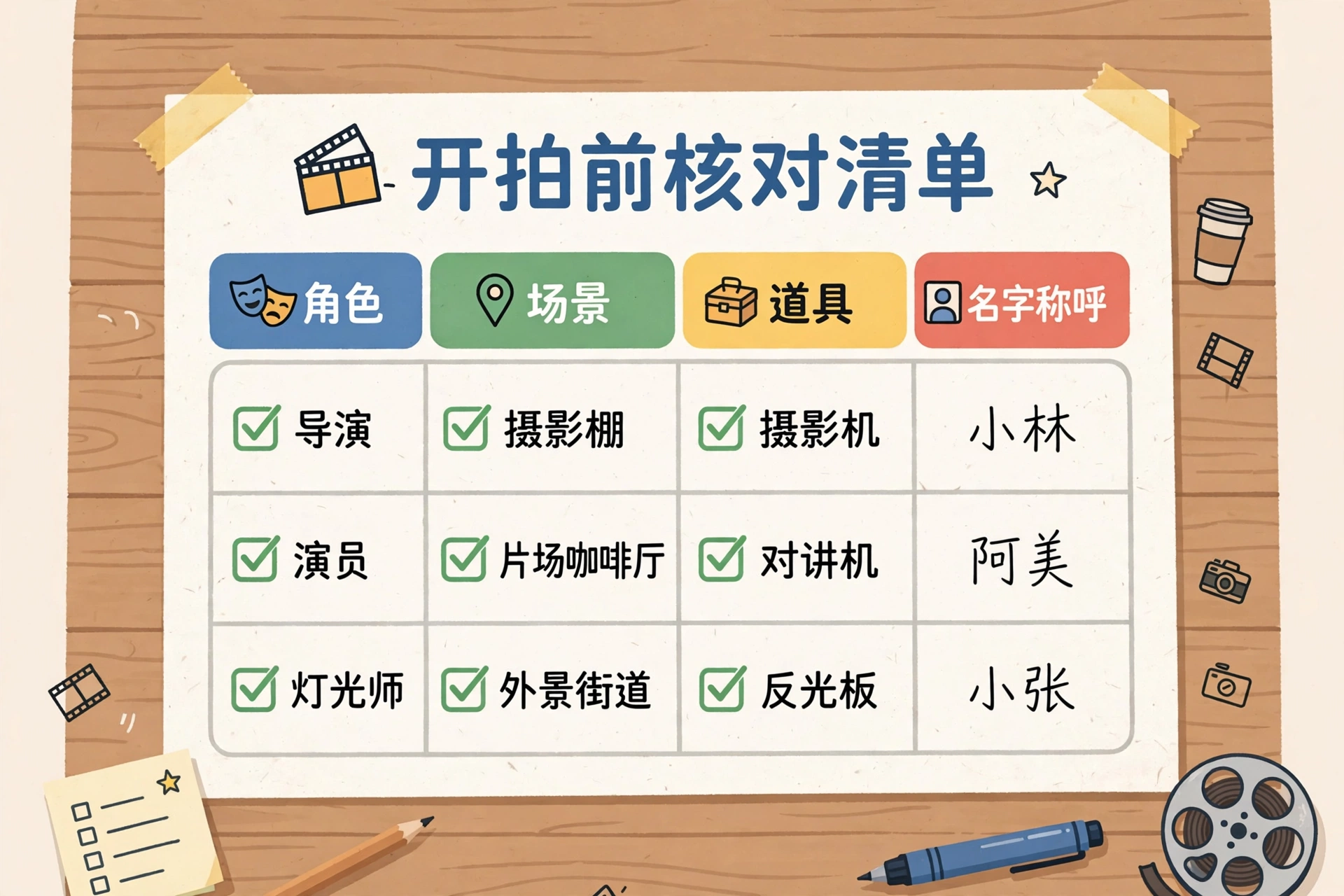
The checklist is four questions: is everyone here, is every place locked, is every prop right, is every name correct? If any one of them has no answer, do not shoot — generation can fill a frame, it cannot fill a missing asset. The assets are the four from the second overseas piece: character, voice, setting and props. This piece is about how to check them all, once, before the shoot.
There is only one way to check: walk the script against the asset list, scene by scene, person by person, object by object. If the script has a person, the list needs a character card for them. If it has a place, the list needs a wide reference image. If an object keeps coming back, the list needs a line in the prop file. Whatever is in the script and missing from the list is rework waiting to happen.
Write the checklist down. Do not keep it in your head: “roughly ready” in your head is the least reliable kind of ready. Written down and ticked off, it counts. And keep it short — four questions, four lists, one page. A long checklist never gets used before a shoot; a short one does.
The trap: checking only before episode one. The further the script goes, the more new people, places and props appear, and every episode needs the new ones checked again. Check episode one only, and the later episodes will be missing and doubled just the same.
02 / Characters
Is Everyone Here? Do Not Split One Person into Two
Count the people first: lead, supporting cast, passers-by. Everyone named in the script needs a card — no exceptions. Unnamed passers-by can be fixed by costume and silhouette alone, without a card each. If the headcount is wrong, the scenes cannot be scheduled — uncast people cannot be blocked.
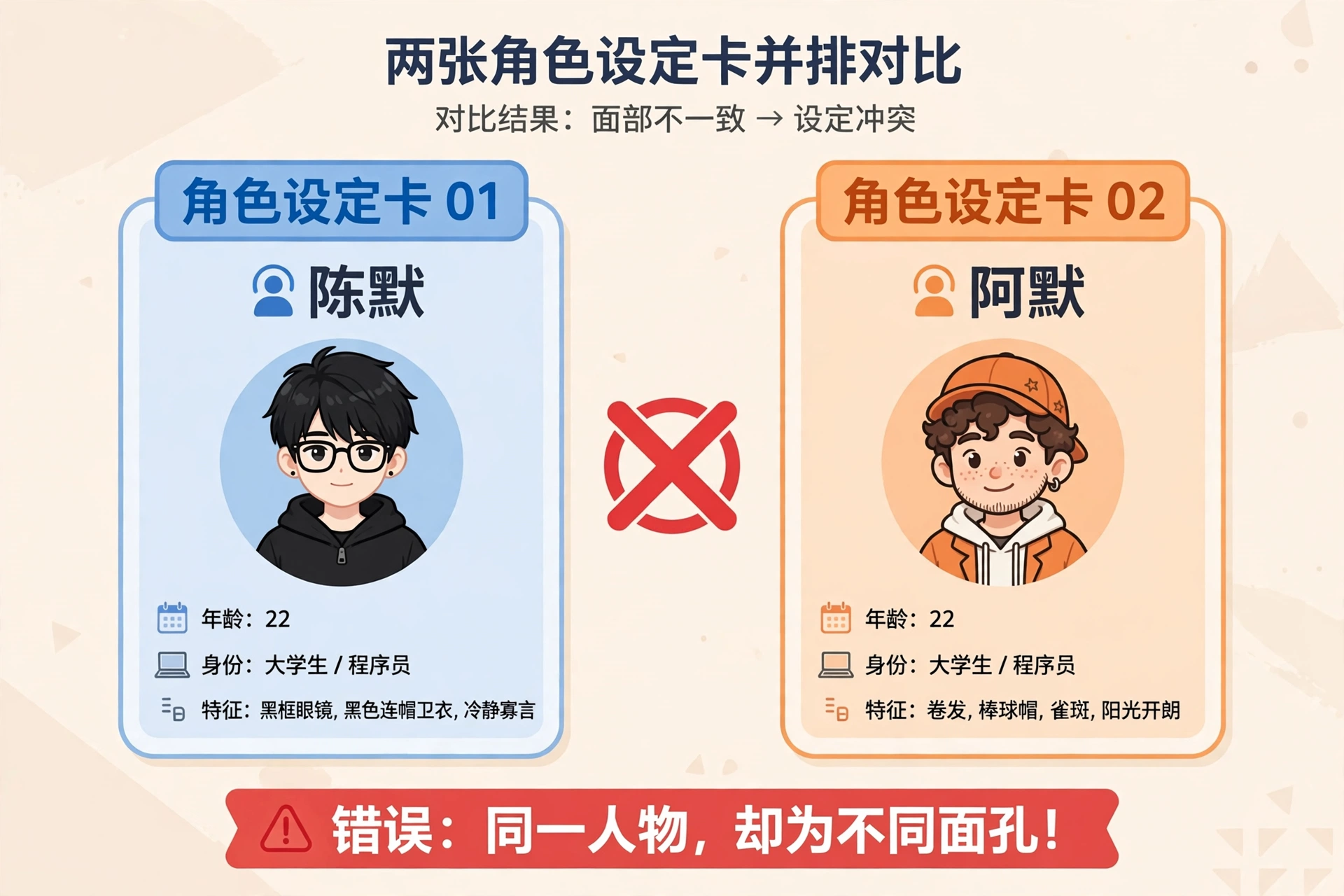
Then check for one person split into two: the same character on two cards, with two names or two faces. It is the worst mistake to make before a shoot. It comes in three common forms: same name, different face — two cards both called Chen Mo, with different faces; same face, different name — one face, called Chen Mo in one place and A-Mo in another; lead and supporting mixed up — a supporting character's card carrying the lead's face. Each one breaks continuity somewhere.
Give detail by screen time: the lead gets the most — front, side and expression reference images, plus name, age, identity and a signature item. Supporting characters get less: face and costume locked is enough. Passers-by get costume and silhouette only. Spread the detail evenly and the lead ends up underdone while the passers-by are overdone — waste on both ends.
The trap: locking the face but not the costume or the signature item. The face is right and the clothes are wrong, and the audience still cannot tell it is the same person. The signature item changes, and the thread the character was carrying snaps. A card is only finished when face, costume and signature item are all on it.
03 / Sets and Props
Is Every Place Locked? Is Every Prop Right?
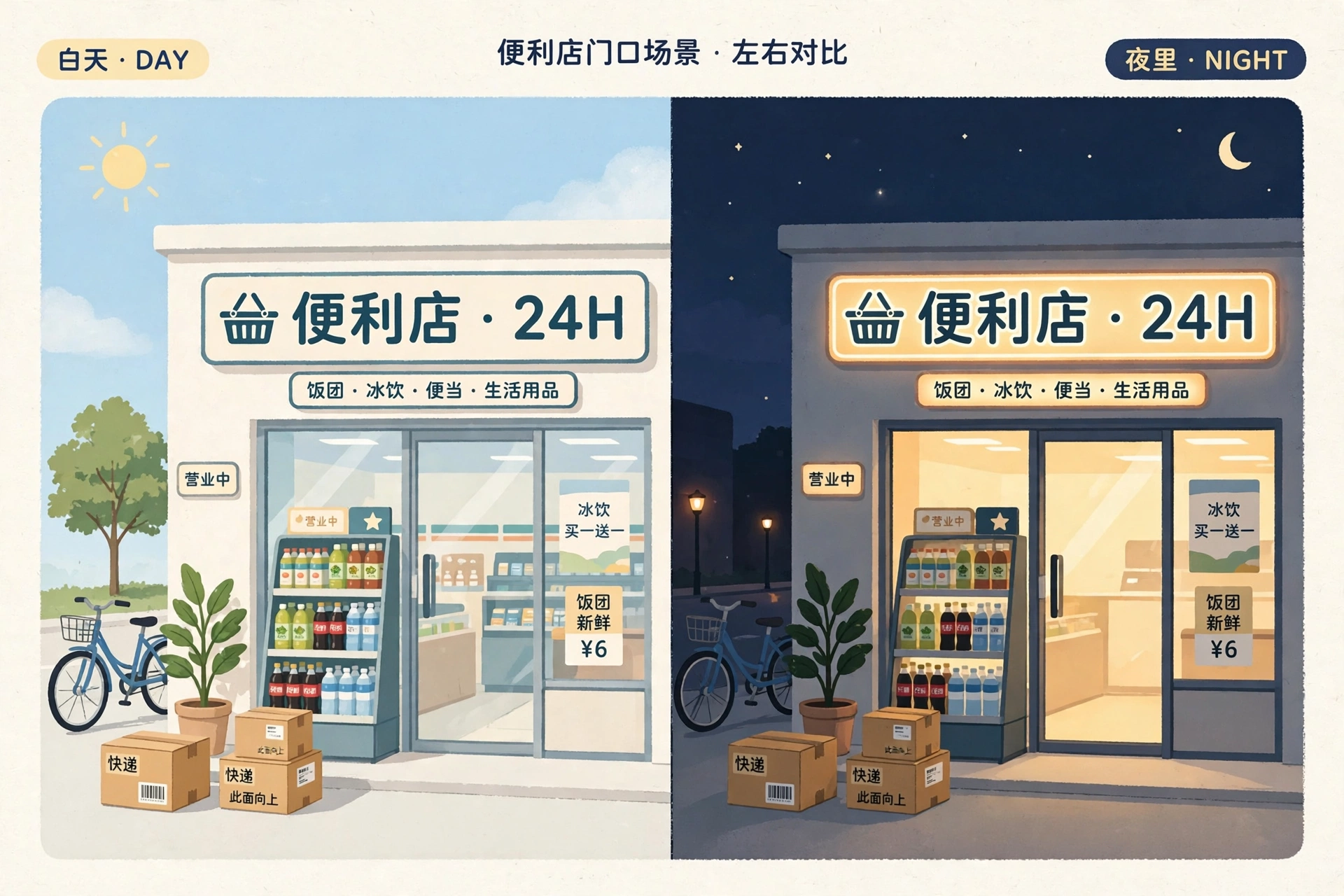
Count the places first: however many main sets the script has, the asset list needs that many wide reference images. The main sets are only a few — an old-town street at night, a convenience store entrance — and each image locks the place, the fixtures, the sign, the light and the season. The camera can move freely; the set cannot. A set left to feel means the sense of space from the last episode is thrown away.
Props get their own file, especially the recurring ones: shape, colour, size and how it appears, one line each. A prop that appears three times in the script and never once in the asset file has to be reinvented in every episode, and the hook it was carrying will break sooner or later. A new market can change the words on the packaging, never the prop itself — the audience reads the plot off the props.
Sets and props also split into surface and skeleton: sign text and street fixtures can change with the market — that is surface. The direction of the street, where the shop entrance sits, where the light comes from — do not move those; that is the skeleton. Move the skeleton and last episode's sense of space is gone; leave the surface untouched and the new market feels wrong.
The trap: locking the set by day but not by night. The same street looks one way by day and another by night, and without a night reference the night scenes have to reinvent their light and fixtures every episode. A main set needs at least one day and one night wide image, locked as a pair.
04 / Names and Address
Names: Do the Script, the Subtitles and the Card Agree?
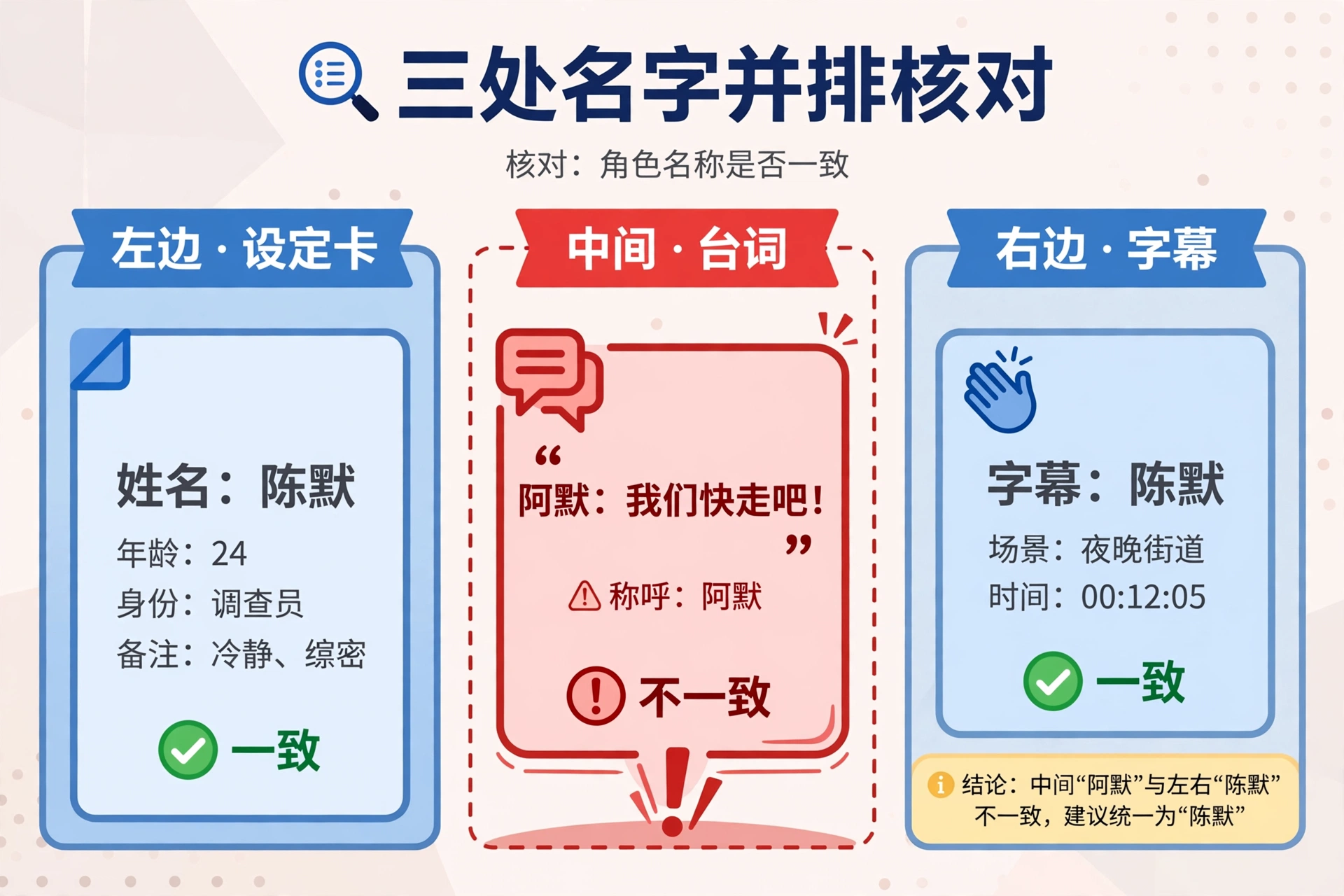
The name list is the shortest, and the easiest to skip: the name on the character card, the name spoken in the dialogue and the name printed in the subtitles must be one name. The dialogue calls him “A-Mo”, the subtitles print “Chen Mo”, the card says “Chen Mo” — and the audience's first thought is that the character changed. A name that drifts is harder to spot than a face that drifts.
Forms of address need checking too: who calls whom what is set by the relationship, not by what sounds smooth. The shop clerk calls the courier “Master Chen”, the courier calls the clerk “A-Tang” — mix the address up and the relationship falls apart with it. Keep the address list on the same page as the name list, so a name change carries its address with it. Never change one place alone.
Changing a name for a new market means changing all three places together: name, dialogue and subtitles at once. Change one and it is the same as changing none. Then run the checklist once more and confirm no old name survives anywhere — one leftover old name means one visible slip in the whole episode.
Walk it through together: before the shoot, list the assets — character, set, props and names — and only shoot when all four are ready. Everyone here, every place locked, every prop right, every name correct: that is when bulk generation is safe to start. Before the checklist clears, the more you generate, the more you rework.
At a Glance
Pre-Shoot Check at a Glance: Four Questions
| Question | Check | Passes when | If it fails |
|---|---|---|---|
| Is everyone here? | Headcount and cards for lead, supporting and passers-by | Everyone named in the script has a card; nobody is split into two | Add the missing card; merge the doubled person into one card |
| Is every place locked? | Wide reference images for main sets, fixtures and light fixed | Camera moves, set does not; day and night are the same place | Lock the wide image before shooting |
| Is every prop right? | Shape, colour, size and appearance of key props | Every prop in the script has a line in the asset file | File the prop on its own before shooting |
| Is every name correct? | Names and address on card, in dialogue and in subtitles | Three places, one name; address follows the relationship | Change all three places together, then check again |
FAQ
FAQ
How detailed should the checklist be?
Detailed enough that someone else could shoot from it: headcount, places, props, names — one missing item is one round of rework. The lead gets the most detail, supporting less, passers-by only costume and silhouette. Detail follows screen time; do not spread it evenly.
Is checking once, before episode one, enough?
No. The further the script goes, the more new people, places and props appear, and every episode needs the new ones checked again. Check episode one only, and the later episodes will be missing and doubled just the same.
Once the checklist clears, can generation still drift?
Less, but not never. The checklist is a floor, not a guarantee: sample each generated batch against the character card, and re-generate on the spot when a face drifts. Do not wait for the edit to find it. Checklist plus sampling is what keeps drift down.
The Point
The Point: Ten Minutes Before the Shoot Saves Ten Episodes of Rework
Check the assets before you shoot: everyone here, every place locked, every prop right, every name correct — then shoot. Four questions only, but every unanswered one is paid back in ten episodes of rework.
Locking the assets was step two of going overseas; this piece is how to check them once, before the shoot — walk the script against the asset list, scene by scene, fill what is missing, merge what is doubled, and line up the names in all three places. The next piece returns to the director's language: shot size, angle, blocking and rhythm are done — the next block is yours to pick.
If you are making AI short dramas or AI commercials, from breaking down a brief to storyboards, continuity control and multi-version delivery, every step needs a director's eye. To talk about how your film gets made, add WeChat newwork88 or email 690076050@qq.com.
Overseas 2: Unified Script Assets → Overseas 3: Generate, Cut, Publish → Shot Sizes in AI Short Drama: One Formula → Character Blocking in AI Short Drama → Camera Angles in AI Short Drama: 3 Questions First → Rhythm in AI Short Drama: Information Divided by Time → Drama Services →
Have a project in mind? Let's talk first.
On the brief page, we can start with the type of film, scope, timeline and delivery — get clear first, then start production.